American hazelnut - Species Profile
Conservation • Wetland • Description • Habitat • Ecology • Use • Distribution • Taxonomy

Conservation Status
IUCN Red List
not listed
NatureServe
N5 - Secure
SNR - Unranked
Minnesota
not listed
Wetland Indicator Status
Great Plains
UPL - Obligate upland
Midwest
FAC - Facultative
Northcentral & Northeast
FAC - Facultative
Description
American hazelnut is a fast-growing, deciduous shrub rising on numerous stems from large, horizontal rhizomes usually 4 ″ to 6″ below the surface of the soil. It often forms a dense, rounded clump that can reach up to 30′ in diameter in favorable conditions. It sometimes forms thickets.
The stems are slender, straight, and sparsely branched. They are usually 5′ to 10′ tall, but mature stems can reach up to 15′ in height and 1¼″ in diameter at breast height. Outer stems become arching and spreading with age.
The bark on young stems is light grayish-brown, shiny, and smooth. On mature stems the bark is somewhat rough, sometimes with finely grooves or ridges. It is not shaggy or peeling. The branches are ascending.
First-year twigs are slender and tan to dark brown. They are covered with long, spreading hairs that are red when young, whitish later; and with stalked glands (glandular hairs) that are visible without magnification. They are sticky to the touch. They sometimes become almost hairless near the end of the first season. Second-year twigs are zigzag and hairless. The buds are broadly egg-shaped, about to ⅛″ long and wide, brownish-gray, and unstalked. They are covered with 4 to 6 scales. The outer bud scales are not deciduous, remaining attached throughout the season. Winter buds are rounded, not angled, at the tip. Flower buds and leaf buds are similar in size and appearance. Leaf scars are small and flat or slightly raised, not depressed. They have 3 bundle scars.
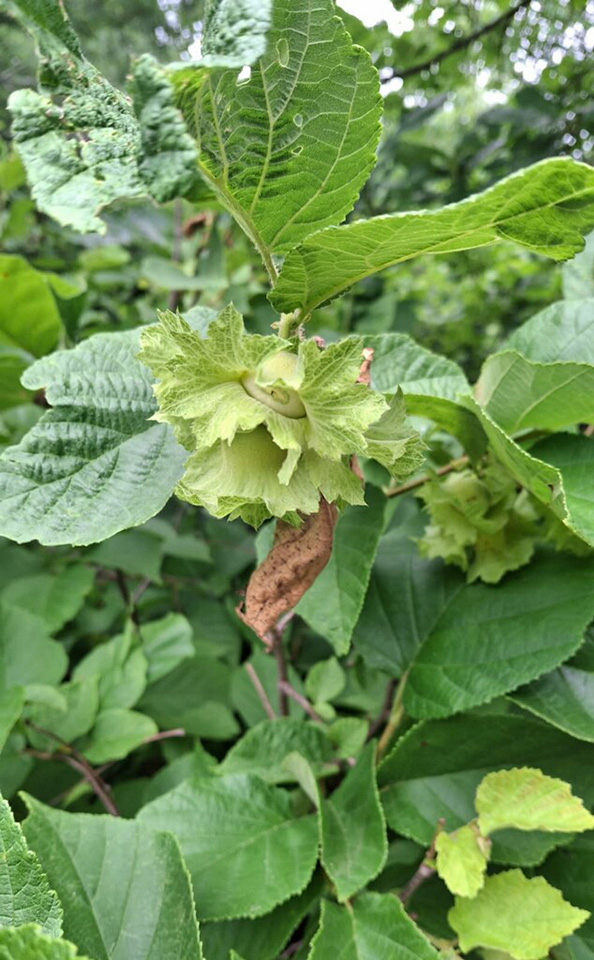
The leaves are alternate, broadly egg-shaped to broadly elliptic or broadly inversely egg-shaped, 2⅜″ to 4¾″ long, and 1⅜″ to 3⅛″ wide. They are attached to the twigs by ¼″ to ¾″ long leaf stalks. The leaf stalk is covered with long, spreading hairs that are red when young, whitish later, and with glandular hairs that are visible without magnification. It is not sticky or resinous. The leaf blade tapers to a sharp point at the tip and is heart-shaped or rounded at the base. It often has straight sides, giving it a squarish appearance, and is occasionally slightly lobed near the tip. There are 6 to 9 lateral veins on each side of the midrib. The lateral veins are sometimes branched. The upper blade surface is dark green and sparsely hairy. The lower surface is paler green, felty to the touch, and covered with soft, spreading hairs, especially along the larger veins. The margin is irregularly doubly toothed with sharp, forward-pointing teeth. In the fall the leaves turn yellow to orange.
Male and female flowers are borne on the same branch. Male flowers appear in late summer singly or in pairs, sometimes in clusters of 3. They are green, slender, cylindrical, drooping clusters of many flowers (catkins). They droop from the leaf axils of twigs of the previous year on woody, ⅛″ to ⅜″ long stalks. They turn brown in the winter. In the early spring they become yellowish and elongate, becoming 1″ to 2¾″ long. The longer male catkins are at least 1½″ long. They shed their pollen in late March to early May.
Female flowers are much smaller, compact, reddish-brown catkins that resemble leaf buds. They are concealed by overlapping scales with only the elongated, bright red stigma and styles exposed. They are subtended by a minute bract and a pair of bractlets. The bractlets get much larger with age, becoming the husk of the fruit.
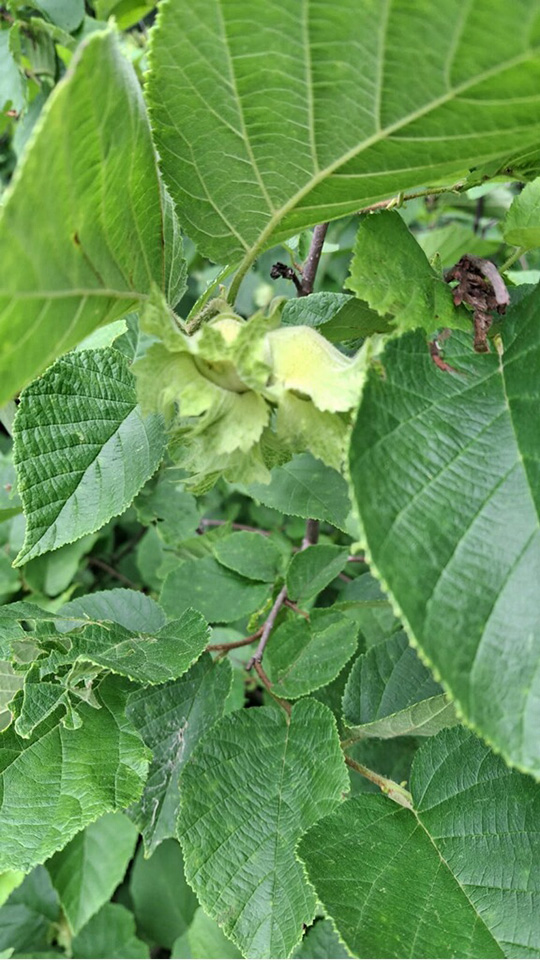
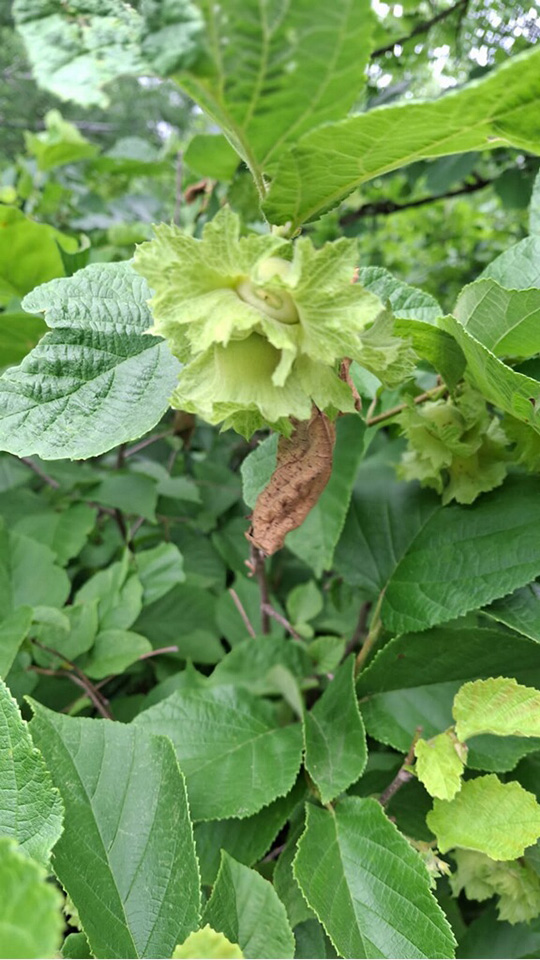
The fruits appear singly or in clusters of usually 2 or 3, sometimes 4 or 5. Each fruit is an edible nut enclosed in a leaf-like husk with a short, broad fringe at the end. The husk is ¾″ to 1⅜″ long, ⅝″ to 1 3 ⁄16″ wide, extending 3 ⁄16″ to ¾″ beyond the nut. It is no more than 2 times as long as the fruit. The fruit is sometimes visible. The husk is covered with both glandular hairs and soft, nonglandular hairs. The nut is more or less globe-shaped and ⅜″ to ⅝″ in diameter. It is enclosed in a hard shell. The fruit matures in late August to late September.
Height
5′ to 15′
Flower Color
Yellowish male catkins in spring
Similar Species
Beaked hazelnut (Corylus cornuta) leaf stalks and first year twigs do not have stalked glands. Mature male catkins are shorter, no more than 1⅜″ long. The husk surrounding the nut forms a long, narrow tube, not a short, broad fringe. The nut is completely concealed by the husk.
Habitat
Dry to moist. Upland deciduous and coniferous forests, especially oak, aspen, and pine forest. Full or partial sun.
Ecology
Flowering
Late March to early May
Pests and Diseases
Use
Distribution

Sources
Biodiversity occurrence data published by: Minnesota Biodiversity Atlas (accessed through the Minnesota Biodiversity Atlas Portal, bellatlas.umn.edu. Accessed 7/11/2024).
Midwest Herbaria Portal. 2026. https://midwestherbaria.org/portal/index.php. Accessed 7/11/2024.
Corylus americana Marshall in Bánki, O., Roskov, Y., Döring, M., Ower, G., Hernández Robles, D. R., Plata Corredor, C. A., Stjernegaard Jeppesen, T., Örn, A., Pape, T., Hobern, D., Garnett, S., Little, H., DeWalt, R. E., Miller, J., Orrell, T., Aalbu, R., Abbott, J., Abreu, C., Acero P, A., et al. (2026). Catalogue of Life (2026-05-15 XR). Catalogue of Life Foundation, Amsterdam, Netherlands. https://doi.org/10.48580/dgxsq
Smith, Welby R. 2008. Trees and Shrubs of Minnesota: The Complete Guide to Species Identification. The University of Minnesota Press, Minneapolis, MN.
Nativity
Native
Occurrence
Common and abundant
Taxonomy
Kingdom
Subkingdom
Pteridobiotina
Phylum
Tracheophyta (Vascular Plants)
Class
Order
Fagales (Beeches, Oaks, Walnuts, and Allies)
Family
Betulaceae (Birch)
Subfamily
Coryloideae
Tribe
Carpineae
Genus
Corylus (Hazels)
Section
Corylus
Subsection
Corylus
Subordinate Taxa
Synonyms
Corylus americana var. indehiscens
Common Names
American filbert
American hazel
American hazelnut
filbert
hazel
hazelnut