



northern bugleweed
(Lycopus uniflorus)
Conservation • Wetland • Description • Habitat • Ecology • Use • Distribution • Taxonomy
Conservation Status |
|
|||||||
| IUCN Red List | not listed |
|||||||
| NatureServe | NNR - Unranked SNR - Unranked |
|||||||
| Minnesota | not listed |
|||||||
Wetland Indicator Status |
||||||||
| Great Plains | OBL - Obligate wetland |
|||||||
| Midwest | OBL - Obligate wetland |
|||||||
| Northcentral & Northeast | OBL - Obligate wetland |
|||||||
Description |
||
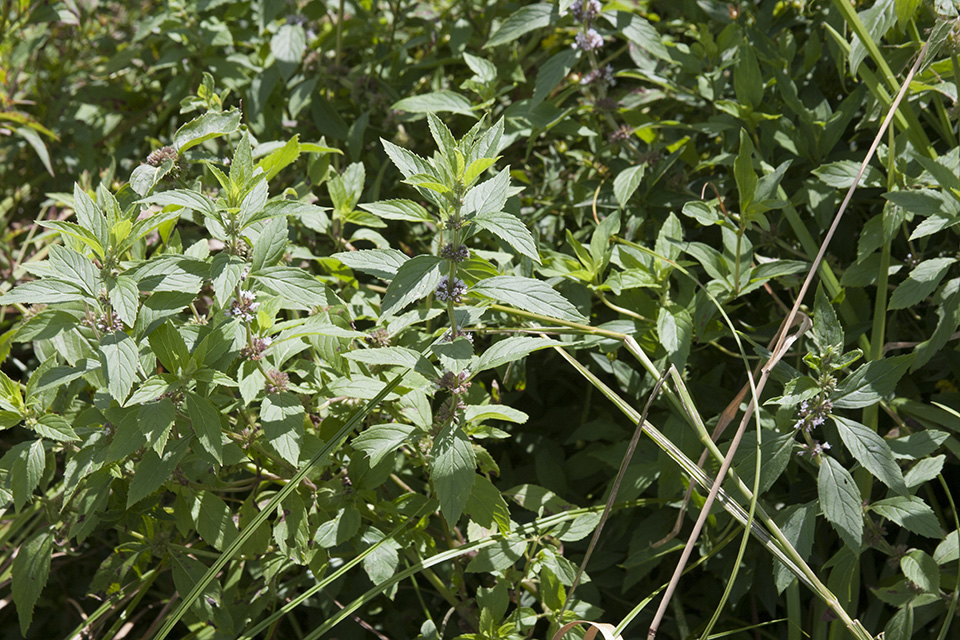
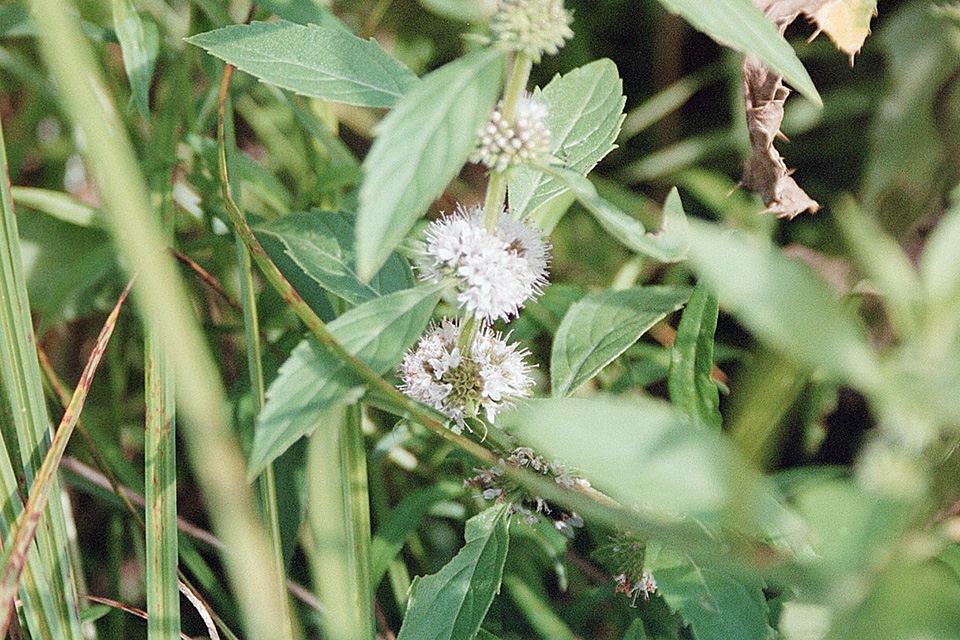
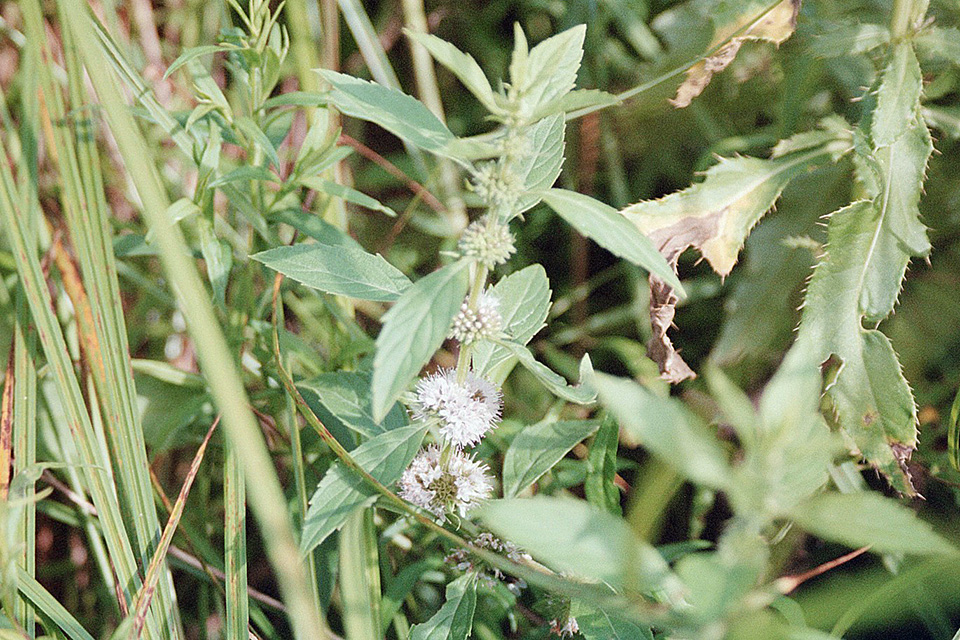
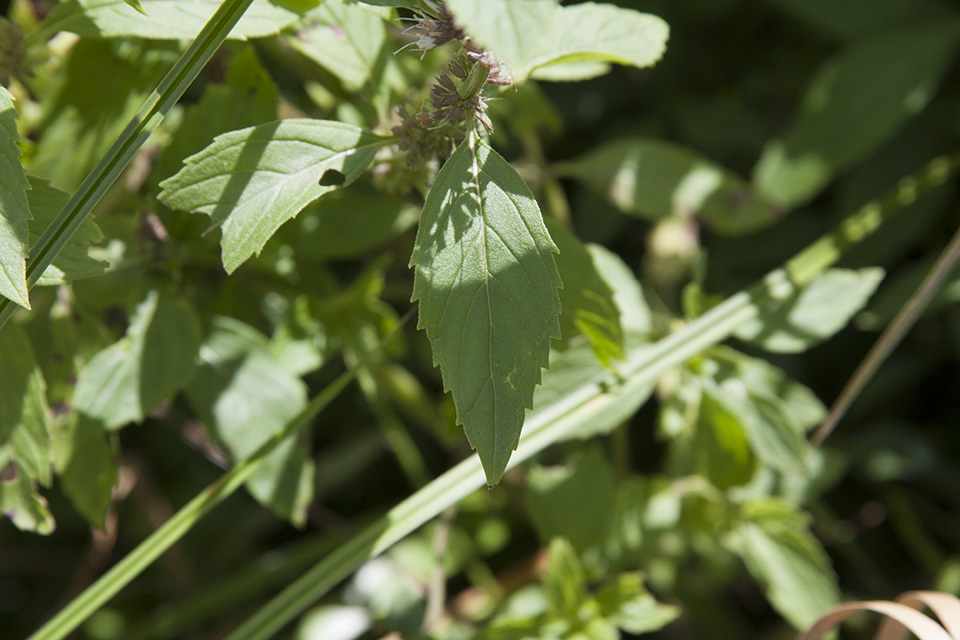
Northern bugleweed is a 4″ to 40″ tall, erect, perennial forb that rises on a solitary stem from a long, slender, horizontal rhizome and fibrous roots. It produces an above-ground runner (stolon) that has a tuber at the tip from which next year’s stem will rise. The stems are ascending to erect, branched or unbranched, green, square, and hollow. They may be hairless or inconspicuously and sparsely hairy, however this character is unreliable (Voss). They are weak and may sprawl without nearby supportive vegetation. There is a single vertical groove on each side of the stem. The leaves are opposite, short-stalked, and unlobed. They are lance-shaped or oblong, ¾″ to 2⅜″ long, and narrow. Each pair of opposite leaves is at right angles to the leaf pairs above and below it. They taper at the tip to a point. They are wedge-shaped at the base with straight or slightly convex, rarely concave, sides along the base. The base of the blade continues along the stalk to or almost to the stem. The lower leaves are short-stalked and toothed, never lobed. They become progressively shorter stalked as they ascend the stem. Upper leaves are stalkless. The upper and lower surfaces are hairless or nearly hairless. The margins are shallowly toothed. Although this is a mint, when crushed the leaves do not smell of mint. The inflorescence is a tight cluster of stalkless flowers in the leaf axils on the upper ⅔ of the stem. Pairs of clusters in opposite leaf axils form false whorls. There are 5 green sepals (calyx) that are united for most of their length into a 1 ⁄16″ to ⅛″ long, bell-shaped tube with 5 teeth. The calyx teeth are firm, less than 1 ⁄32″ long, broadly triangular, and obtuse at the tip. They are more than half as wide at the base as they are long. There are 5 white petals (corolla) that are united at the base into a tube that is barely longer than the calyx tube. The corolla is separated at the tip into an upper lip with 2 lobes and a lower lip with 3 lobes. There are 2 fertile stamens with brown anthers and 2 sterile stamens (staminodes). The stamens and the style are longer than corolla tube. The staminodes are club-like and are shorter than the corolla tube. The flowers are not fragrant. The fruit is a set of 4 egg-shaped, brown, hairless, ridged nutlets with one seed each. The inner angle is shorter than the outer ones so that the center of the nutlets is depressed. When the fruit is mature the nutlets surpass the calyx lobes. The ridges on the nutlets are corky, aiding dispersal by allowing the nut to float on water. |
||
Height |
||
4″ to 40″ |
||
Flower Color |
||
White |
||
Similar Species |
||
American bugleweed (Lycopus americanus) does not produce tubers. The leaves are longer and have deep, coarse, irregular teeth. The lower leaves are lobed near the base. The calyx teeth are longer, 1 ⁄16″ to ⅛″ long, narrow, and sharply pointed, more than twice as long as their base is wide. When the fruit is mature the calyx lobes surpass the nutlets. The corolla has 4 lobes, not 5. Rough bugleweed (Lycopus asper) leaves are longer and are coarsely, not shallowly, toothed. They are broad at the base and are stalkless. The calyx teeth are longer, 1 ⁄16″ to ⅛″ long, narrow, and sharply pointed, more than twice as long as their base is wide. When the fruit is mature the calyx lobes surpass the nutlets. The corolla has 4 lobes, not 5. Sherard’s waterhorehound (Lycopus X sherardii) is a hybrid between this species and Virginia bugleweed. It is found wherever the ranges of the two species overlap. Virginia bugleweed (Lycopus virginicus) does not produce tubers. The leaves are longer and are hairy on the upper and lower surfaces. The leaf margins are toothed from just below the middle to the tip, and untoothed and long concave-tapered below that point. The calyx has 4 teeth, not 5. The corolla has 4 lobes, not 5. The stamens are shorter than corolla tube. The cluster of 4 nutlets is flat across the top, not depressed. |
||
Habitat |
||
Wet or moist. Marshes, wet meadows, fens, stream banks, ditches, lake shores. Partial sun or full shade. |
||
Ecology |
||
Flowering |
||
July to September |
||
Pests and Diseases |
||
|
||
Use |
||
|
||
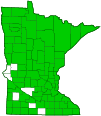
Distribution |
||||
|
Sources |
|||
| 5/21/2023 | ||||
Nativity |
||||
Native |
||||
Occurrence |
||||
Common |
||||
Taxonomy |
|||
| Kingdom | Plantae (Plants) | ||
| Subkingdom | Pteridobiotina | ||
| Phylum | Tracheophyta (Vascular Plants) | ||
| Class | Magnoliopsida (Dicots) | ||
Order |
Lamiales (Mints, Plantains, Olives, and Allies) | ||
Family |
Lamiaceae (Mint) | ||
| Subfamily | Nepetoideae | ||
| Tribe | Mentheae | ||
Subtribe |
Lycopinae (water horehound) | ||
| Genus | Lycopus (water horehounds) | ||
Lycopus was formerly placed in the subtribe Menthinae. A recent comprehensive phylogenetic analysis of the tribe Mentheae of the family Lamiaceae (Drew and Sytsma, 2012) showed strong support for separating the genus Lycopus into a separate subtribe Lycopinae. The move has not been universally accepted. |
|||
Subordinate Taxa |
|||
USDA PLANTS and ITIS list two varieties, Lycopus uniflorus var. ovatus and Lycopus uniflorus var. uniflorus. Of these, only var. uniflorus occurs in Minnesota. Most sources recognize no varieties. |
|||
Synonyms |
|||
Lycopus uniflorus var. ovatus Lycopus uniflorus var. uniflorus |
|||
Common Names |
|||
bugleweed northern bugleweed northern water-horehound oneflower bugleweed slender bugleweed |
|||
Glossary
Axil
The upper angle where a branch, stem, leaf stalk, or vein diverges.
Calyx
The group of outer floral leaves (sepals) below the petals, occasionally forming a tube.
Corolla
A collective name for all of the petals of a flower.
Rhizome
A horizontal, usually underground stem. It serves as a reproductive structure, producing roots below and shoots above at the nodes.
Sepal
An outer floral leaf, usually green but sometimes colored, at the base of a flower.
Staminode
A modified stamen that produces no pollen. It often has no anther.
Stolon
An above-ground, creeping stem that grows along the ground and produces roots and sometimes new plants at its nodes. A runner.
Visitor Photos |
|||||
Share your photo of this plant. |
|||||
| This button not working for you? Simply email us at info@MinnesotaSeasons.com. Attach one or more photos and, if you like, a caption. |
|||||
|
|||||
MinnesotaSeasons.com Photos |
|||||
Plant |
|||||
 |
|||||
Inflorescence |
|||||
 |
 |
||||
Leaves |
|||||
 |
|||||

Slideshows |
||
Visitor Videos |
|||
Share your video of this plant. |
|||
| This button not working for you? Simply email us at info@MinnesotaSeasons.com. Attach a video, a YouTube link, or a cloud storage link. |
|||
Other Videos |
|||

Visitor Sightings |
|||||
Report a sighting of this plant. |
|||||
| This button not working for you? Simply email us at info@MinnesotaSeasons.com. Be sure to include a location. |
|||||
|
|||||
MinnesotaSeasons.com Sightings |
|||||
|
Created: Last Updated: © MinnesotaSeasons.com. All rights reserved. |