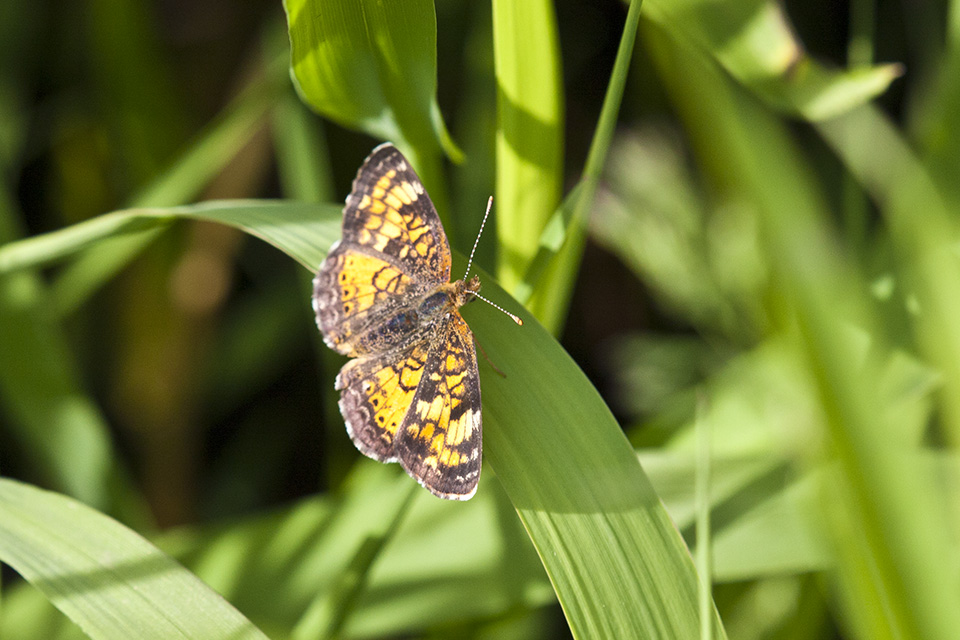
Northern Crescent - Species Profile
Conservation • Description • Habitat • Ecology • Distribution • Taxonomy

Conservation Status
IUCN Red List
not listed
NatureServe
N5 - Secure
S5 - Secure
Minnesota
not listed
Description
Northern crescent is a medium sized brushfoot butterfly. It has a wingspan of 1″ to 1⅜″. It is very common in Minnesota.
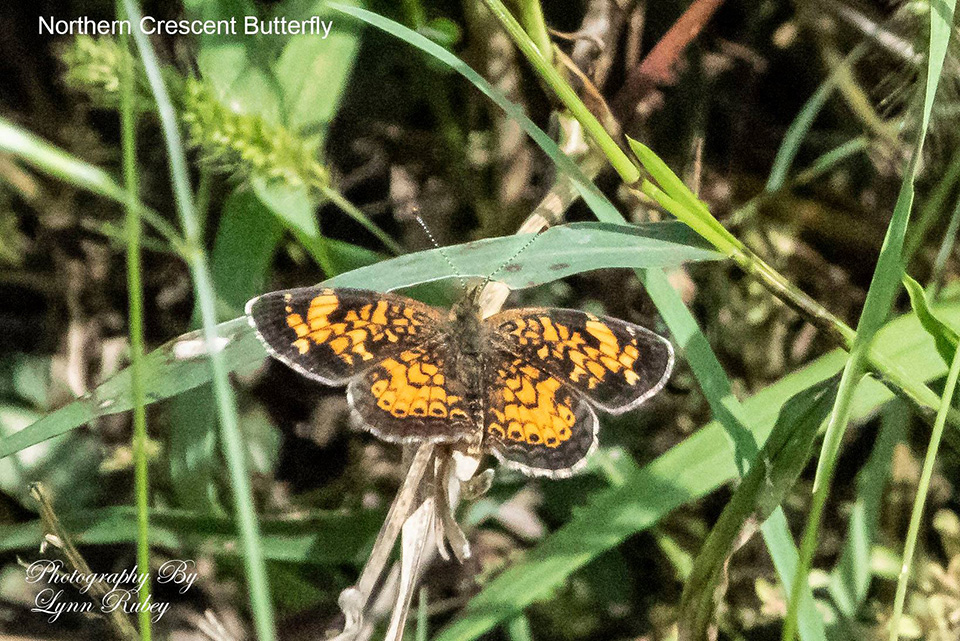
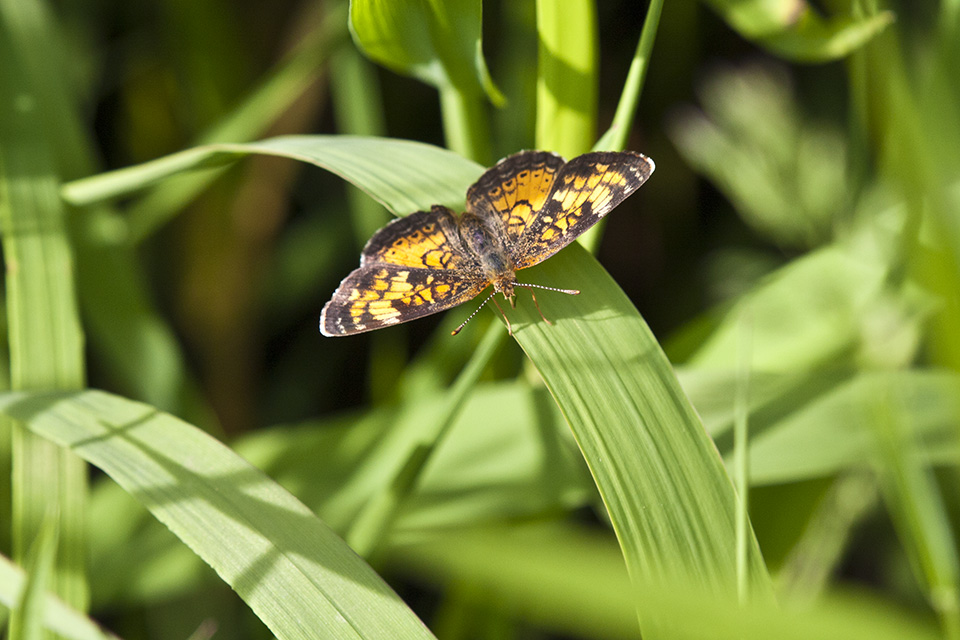
The upperside of the both wings is orange with a broad black border and a black-and-white fringe. There is a small to large patch in the basal area that is is mostly black with many fine, pale specks. The female is larger, darker, and more extensively marked than the male.
The upperside of the forewing has four irregular black patches: a subapical patch that merges with the black border; a submarginal patch near the inner margin that merges with the black border; a median patch on the leading (costal) margin; and a median patch on the inner margin. On most individuals, a black jagged line separates the median area from the postmedian area and widens into an irregular black patch near the costal margin. On the female, the median area is yellowish-orange. There are jagged lines in the discal area that form one or two outer and a row of inner orange spots with black borders.
The upperside of the hindwing has a submarginal row if pale, crescent-shaped spots within the black border. There is a broad, open, median and postmedian area with row of small black spots and jagged, interrupted, postmedian line. Jagged lines in the discal area create three rows of irregular orange spots with black borders.
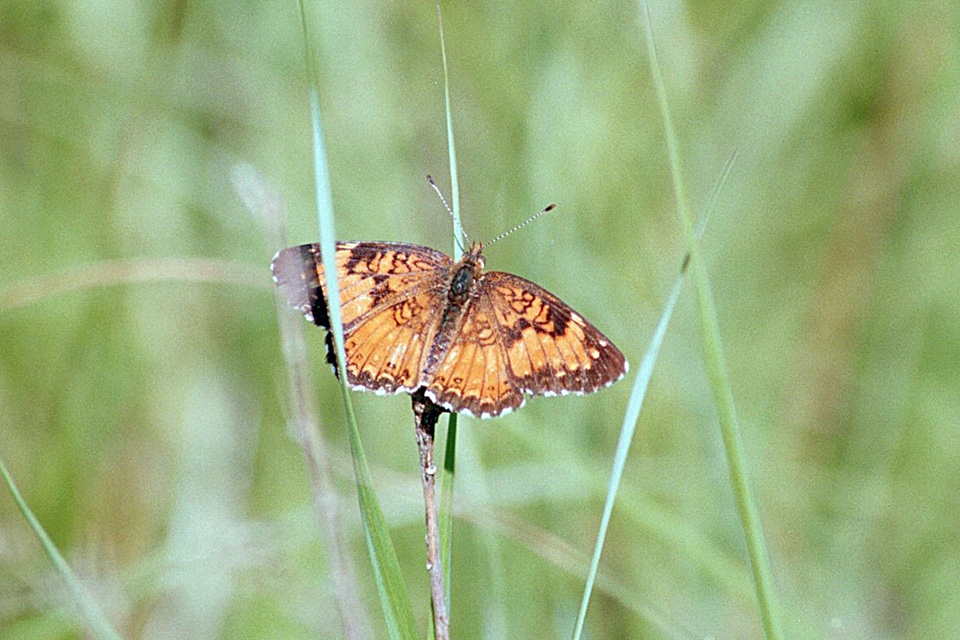
The underside of the forewing is orange with pale orange costal and apical areas; thin, jagged, dark orange lines; and two ill-defined black patches near the costal margin.
The underside of the hindwing is pale orange with thin, jagged, dark orange lines; an ill-defined, dark orange patch near the costal margin, and a dark brown patch near the trailing edge. On females, the pale areas are orangish-yellow and the lines are more highly contrasted.
The antennae are black and white striped. The antenna clubs are black and white striped with an orange tip. The legs are orangish-yellow.
The caterpillar is up to ¾″ long and dark brown with numerous tiny white spots. The spots are the expanded base of the hairs (seta). On the thorax and each abdominal segment there is a short, branched spine (scolus) in the middorsal, subdorsal, supraspiracular, spiracular, and subspiracular regions. The base of the scolus is rounded, wart-like, reddish-orange, and shiny. There is a broken white line in the subdorsal and subspiracular areas that extends onto the head.
Size
Wingspan: 1″ to 1⅜″
Similar Species
Pearl crescent (Phyciodes tharos) has a smaller speckled black area on the wing uppersides near the body. The hindwing postmedian line is continuous and unbroken. There is a pearly white spot in the brown patch in the underside of the hindwing. The flight season begins in May.
Habitat
Meadows, fields, streamsides, roadsides, and other moist open spaces.
Ecology
Season
Two broods: June to early July, and August to mid-September
Behavior
Young caterpillars feed in groups but do not create nests.
Life Cycle
The male patrols near host plants in search of a receptive female. After mating, the female lays green eggs on the underside of aster leaves in a raft of usually about 40 but as few as 20 to as many as 300. The second brood overwinters as a third-stage caterpillar.
Larva Food/Hosts
White panicle aster (Symphyotrichum lanceolatum), smooth blue aster (Symphyotrichum laeve), and other asters (Symphyotrichum spp.).
Adult Food
Flower nectar of spreading dogbane (Apocynum androsaemifolium), white clover (Trifolium repens), fleabane (Erigeron spp.), thistle (Cirsium spp.), and aster (Symphyotrichum spp.).
Distribution

Sources
7, 21, 24, 27, 30, 75, 82, 83.
Biodiversity occurrence data published by: Minnesota Biodiversity Atlas (accessed through the Minnesota Biodiversity Atlas Portal, bellatlas.umn.edu. Accessed 7/12/2024).
Phyciodes cocyta (Cramer, 1779) in Bánki, O., Roskov, Y., Döring, M., Ower, G., Hernández Robles, D. R., Plata Corredor, C. A., Stjernegaard Jeppesen, T., Örn, A., Pape, T., Hobern, D., Garnett, S., Little, H., DeWalt, R. E., Miller, J., Orrell, T., Aalbu, R., Abbott, J., Abreu, C., Acero P, A., et al. (2026). Catalogue of Life (2026-06-19 XR). Catalogue of Life Foundation, Amsterdam, Netherlands. https://doi.org/10.48580/dgy8b
Quinn, Edward. M., and Ron Danielson. April 27, 2009. A Survey of Lepidoptera in Three Priority Areas of the Minnesota State Parks System. https://files.dnr.state.mn.us/eco/nongame/projects/consgrant_reports/2009
/2009_quinn_danielson.pdf.
Occurrence
Very common
Taxonomy
Order
Lepidoptera (Butterflies and Moths)
Superfamily
Papilionoidea (Butterflies)
Family
Nymphalidae (Brush-footed Butterflies)
Subfamily
Nymphalinae (Checkerspots, Anglewings, Peacocks, and Allies)
Tribe
Melitaeini (Checkerspots)
Subtribe
Phyciodina
Genus
Phyciodes (Crescents)
Species or Subspecies?
Northern crescent (Phyciodes cocyta) was formerly considered a synonym of P. tharos. It is a species that has recently diverged (recent in evolutionary terms) from Pearl Crescent (Phyciodes tharos). Gene flow between recently diverged species is not uncommon. In fact, it is expected. But it is especially common between P. cocyta and P. tharos. This has led some taxonomists to suggest that P. cocyta is a subspecies of P. tharos.
The Phyciodes tharos group contains 4 species that are closely related genetically: P. tharos, P. cocyta, P. batesii, and P. pulchella. A molecular phylogenetics, phylogenomics, and phylogeography study of crescent butterflies in the Phyciodes tharos group was published on March 28, 2024 (Wingert et al., 2024). The authors concluded that “Phylogenetic and cluster-based analyses confirm that there are indeed 4 species based on the maintenance of genomic integrity in the presence of occasional hybridization and low levels of gene flow.”
Global Biodiversity Information Facility (GBIF) classifies P. cocyta as a synonym of P. tharos. They appear to be unique in doing so. They list the subspecies of P. cocyta under P. tharos, yet they keep the former subspecies’ trinomial names. For example, under Phyciodes tharos, they list the subspecies Phyciodes cocyta subsp. cocyta, Phyciodes cocyta subsp. diminutor, and Phyciodes cocyta subsp. selenis. They appear to be unique in doing this as well.
Minnesota Biodiversity Atlas lists only Phyciodes selenis/tharos.
Subordinate Taxa
Diminutive Northern Crescent (Phyciodes cocyta diminutor) 
Mimic Crescent (Phyciodes cocyta incognitus)
Northern Crescent (Phyciodes cocyta cocyta)
Northern Crescent (Phyciodes cocyta pascoensis)
Northern Crescent (Phyciodes cocyta selenis)
Steptoe Valley Checkerspot (Phyciodes cocyta arenacolor)
Synonyms
Melitaea marcia
Melitaea selenis
Papilio cocyta
Papilio morpheus
Phyciodes apache
Phyciodes arctica
Phyciodes arenacolor
Papilio cocyta
Phyciodes dyari
Phyciodes herse
Phyciodes macdunnoughi
Phyciodes mcdunnoughi
Phyciodes nigrescens
Phyciodes pascoensis
Phyciodes reaghi
Phyciodes selenis
Common Names
Northern Crescent