



western bracken fern
(Pteridium aquilinum var. latiusculum)
Conservation • Wetland • Description • Habitat • Ecology • Use • Distribution • Taxonomy
Conservation Status |
|
|||||||
| IUCN Red List | not listed |
|||||||
| NatureServe | N5 - Secure SNR - Unranked |
|||||||
| Minnesota | not listed |
|||||||
Wetland Indicator Status |
||||||||
| Great Plains | FACU - Facultative upland |
|||||||
| Midwest | FACU - Facultative upland |
|||||||
| Northcentral & Northeast | FACU - Facultative upland |
|||||||
Description |
||
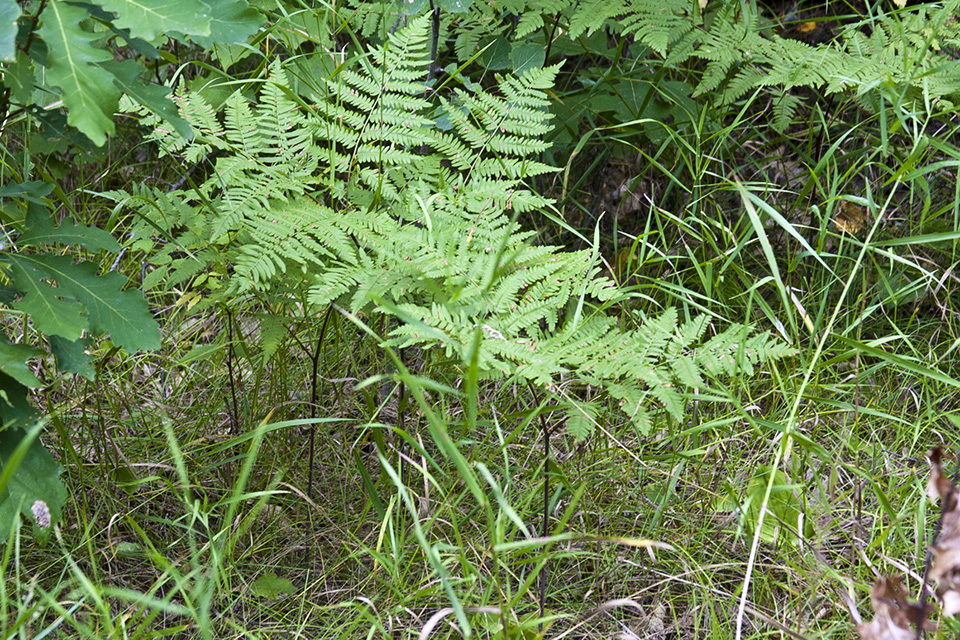
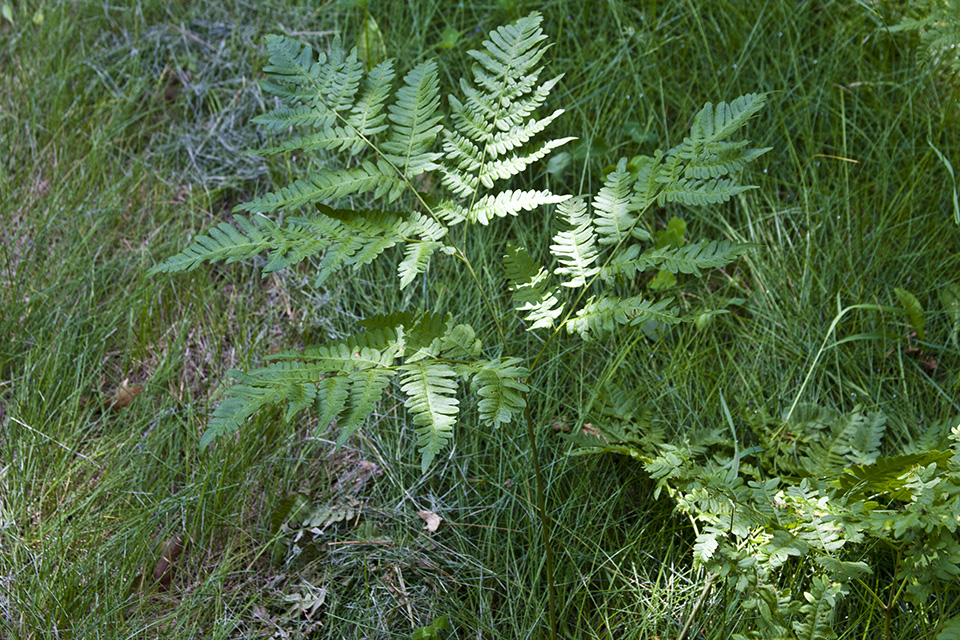
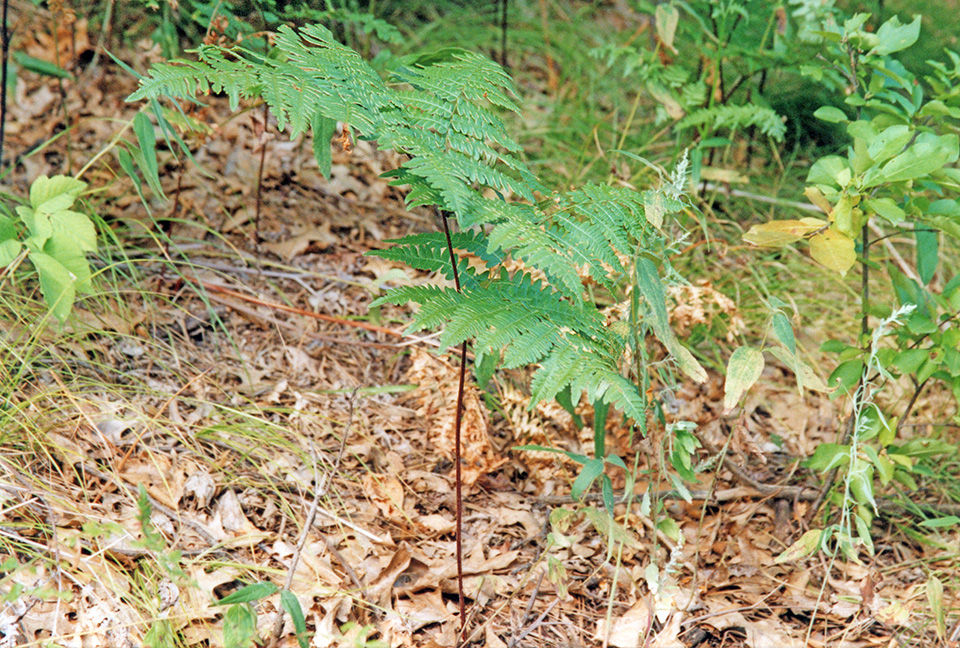
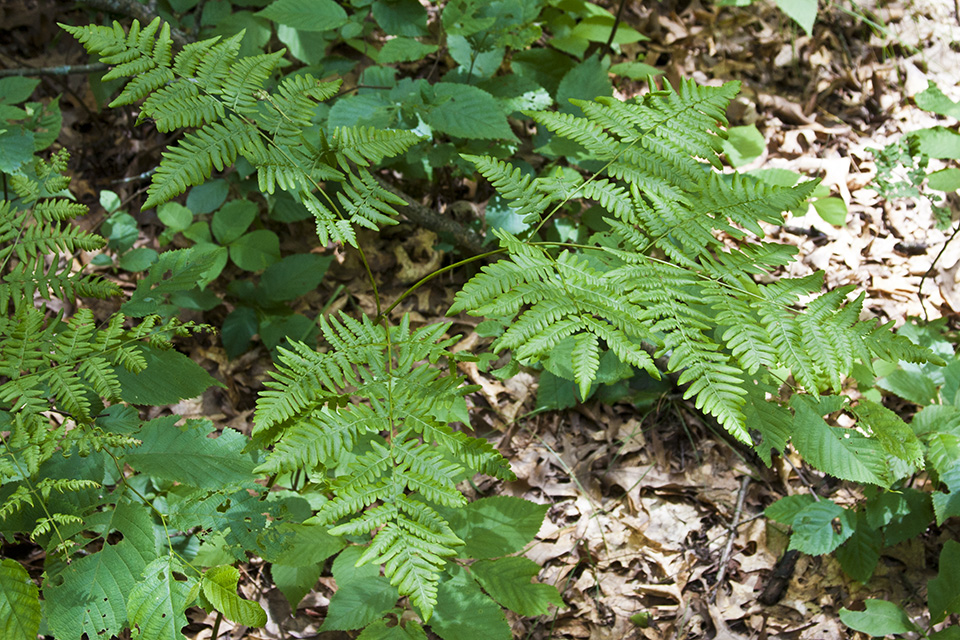
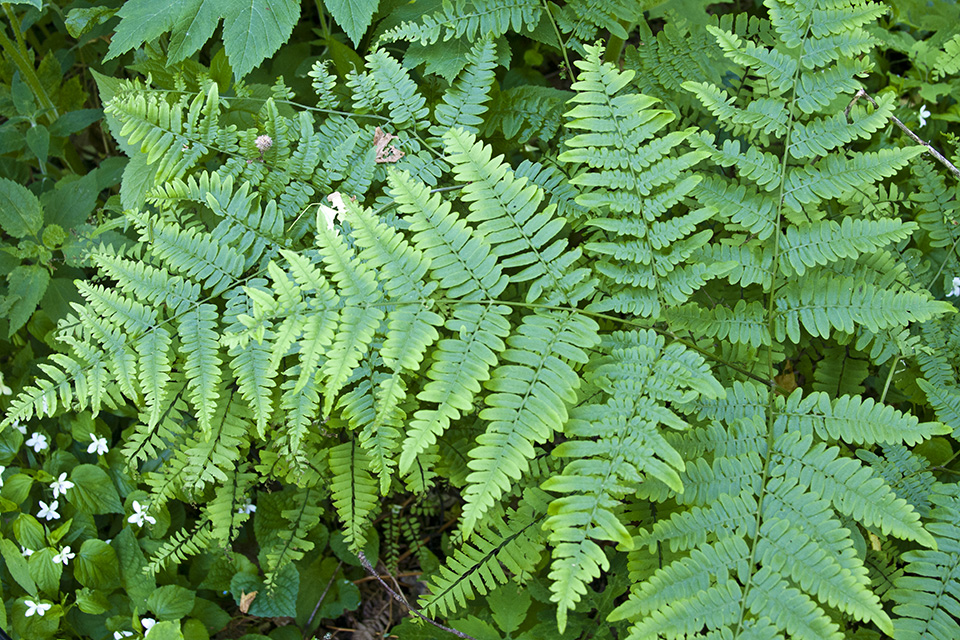
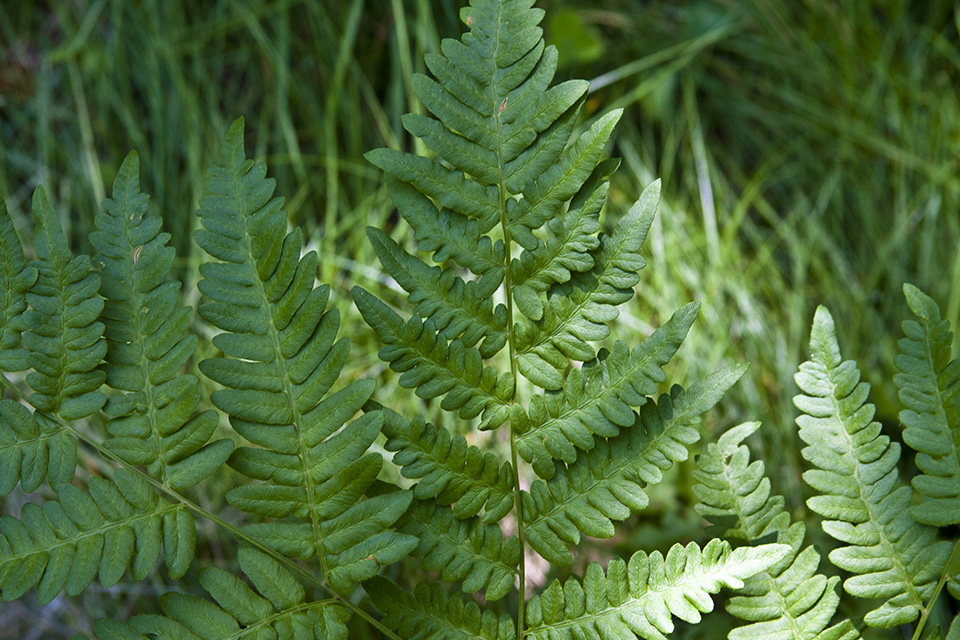
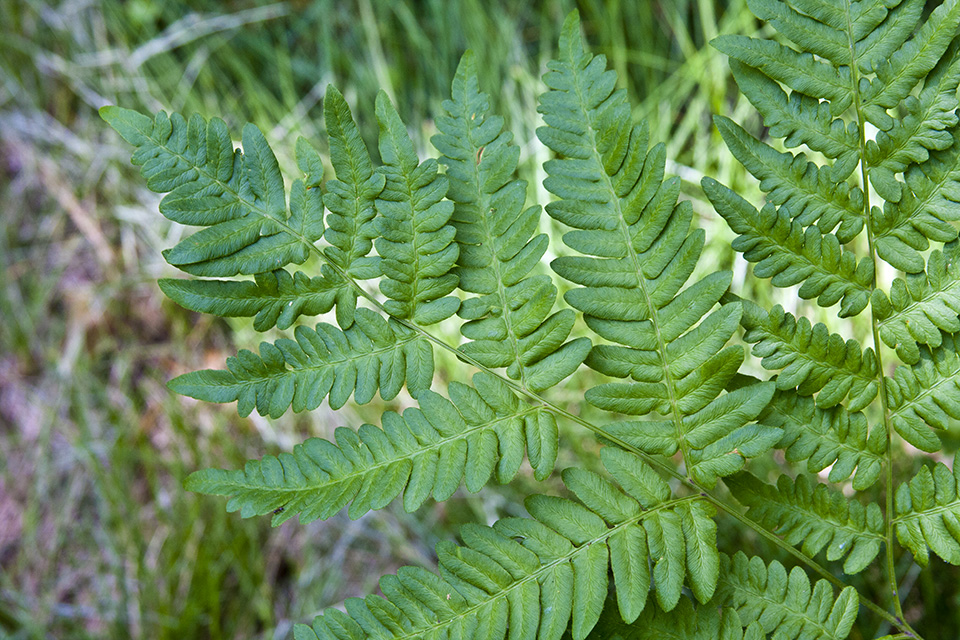
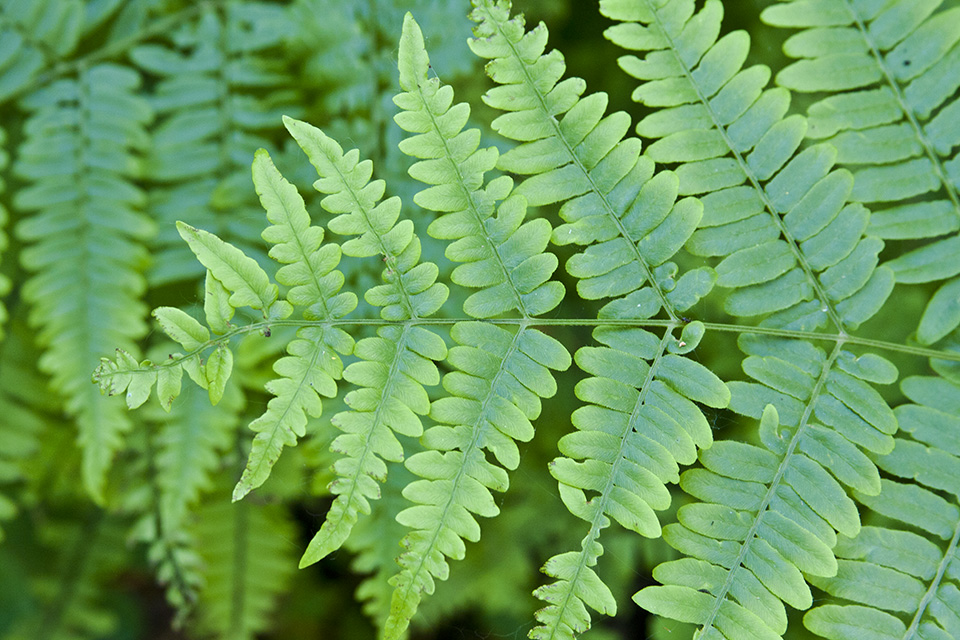
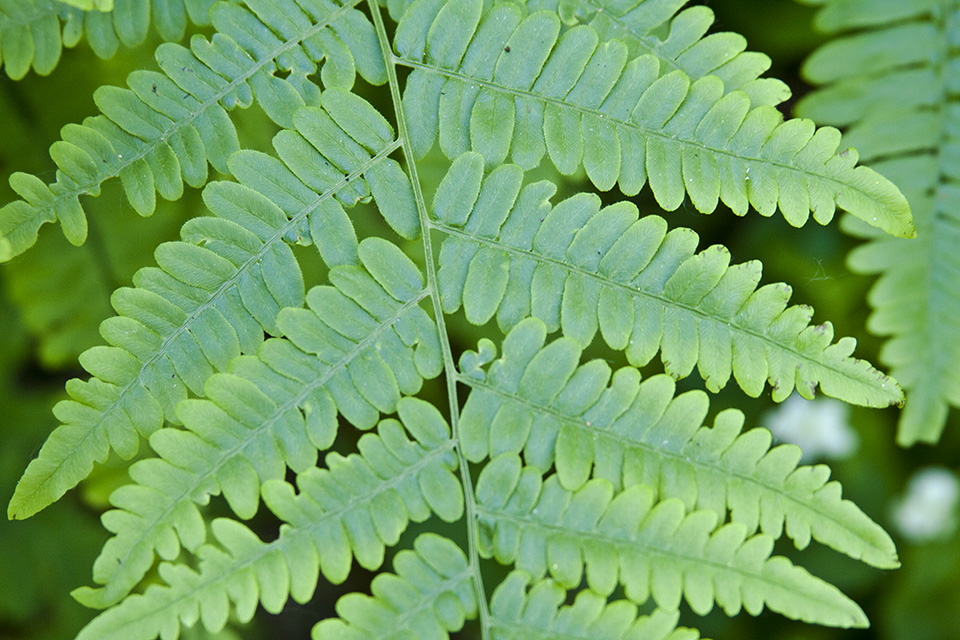
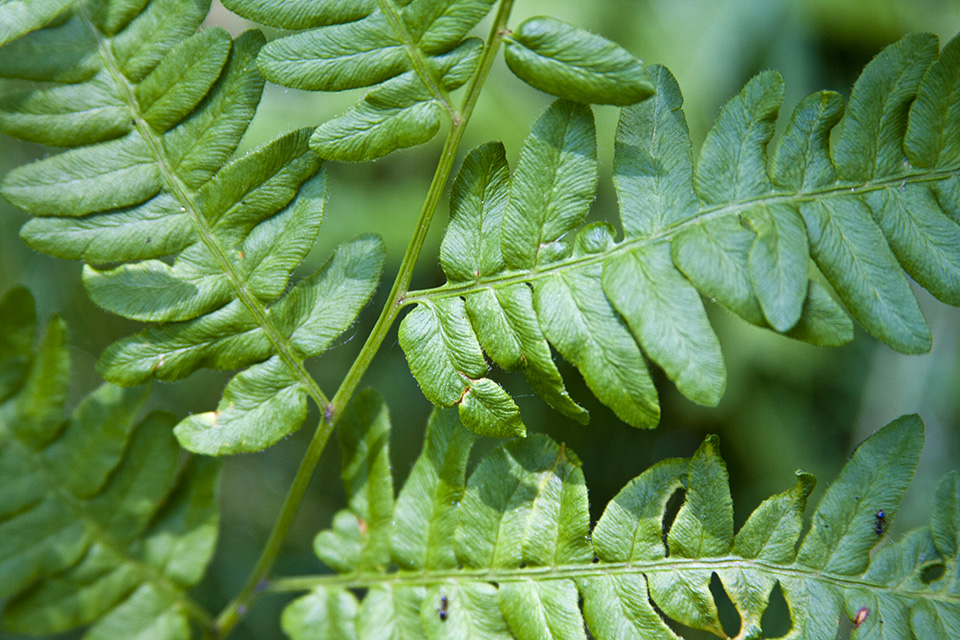
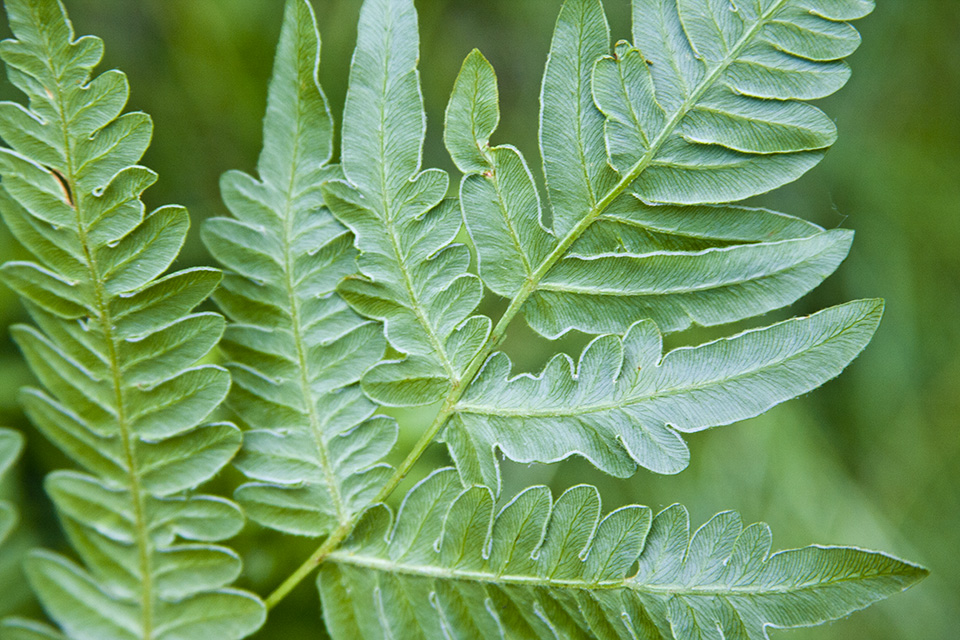
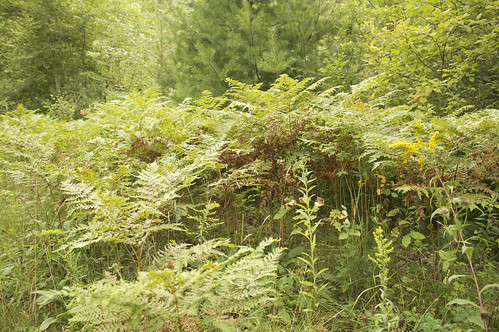
Western bracken fern is a relatively large, coarse, perennial fern that rises as single, widely spaced leaves (fronds) from an underground, often deep, horizontal stem (rhizome). It often forms large colonies or thickets. The rhizome is slender, long-creeping, and often branched. There are no aerial stems. Fronds rise directly from the underground rhizome. The fronds are deciduous and erect. They may be 12″ to 60″ tall, but are usually no more than 36″ in height. They are well spaced, 1′ to 5′ apart. The leaf stem (stipe) is 6″ to 40″ long, about the same length as the leafy portion (blade). It is green at first, turning brown later in the season. It is stout, rigid, and hairless. It is shallowly or deeply grooved on the upper surface, making it U-shaped in cross section. It does not have prickles or scales. The blade is broadly triangular in outline, 8″ to 32″ long, 10″ to 20″ wide, and 3 times pinnately divided. It is yellowish-green to dark green and papery or leathery in texture. It is divided into 3 more or less equal parts (branches), a central branch and 2 lateral branches. In shady areas the branches are held more or less parallel to the ground. In sunny areas they are held more vertically. The branches are pinnately divided divided into 10 or 12 pairs of primary segments or leaflets (pinnae). The pinnae are arranged alternately but closely spaced (subopposite) on the central axis (rachis) of each branch. They spread from the rachis at a 45° to 60° angle. The rachis is green and hairless or sparsely covered on the lower surface with long, soft, straight hairs. There are no prickles or scales on the rachis. The lowermost pair of pinnae on the terminal branch and sometimes on the lateral branches are larger and more divided than the rest. They are broadly triangular in outline and are each nearly as long as the remaining portion of the branch. They are distinctly stalked. The lower portion of the lowermost pinnae is pinnately divided into leaflets (pinnules) that are clearly separated at the base from the central axis (costa) of the pinna. The upper portion is pinnately divided into subleaflets that are not separated at the base from the costa. Middle and upper pinnae become shorter and less divided as they approach the tip. They are unstalked and narrowly triangular in outline. Middle pinnae are pinnately divided into subleaflets. Uppermost pinnae are merely pinnately lobed or are unlobed. The upper surface of the costa is grooved. The lower surface is sparsely to densely covered with shaggy hairs. The ultimate segments (subleaflets) are egg-shaped to oblong or linear, narrow, blunt-tipped, and closely spaced. The larger ones are lobed with a terminal lobe that is 2 to 4 times as long as wide. This gives the pinnae the appearance of having a short-tapering tip. The margins of the pinnae are strongly bent backward (reflexed) toward the underside. The margins and lower surface are covered with shaggy hairs. The veins visible on the underside are forked and free, meaning they do not rejoin to form a network but rather extend to a marginal vein beneath the sori. The central axis of the pinnule (costule) is grooved on the upper surface. The U-shaped groove of the costule connects with the groove of the costa, which connects to the groove of the rachis, which connects to the groove of the stipe. The reproductive structures are born on the underside of the pinnules. There is a nearly continuous line of compact clusters (sora) of spore-bearing cases (sporangia) along the lower margin of the pinnule. The sorus is covered with a protective veil (indusium). The indusium is poorly developed and is hidden by the reflexed margin of the pinnule. |
||
Height |
||
12″ to 36″ |
||
Similar Species |
||
Rattlesnake fern (Botrypus virginianus) is much smaller, no more than 18″ in height. The pinnules are more finely cut and do not have an extended terminal lobe. The fertile portion is an extension of the stipe that sticks straight up, looking like a separate frond. Western oak fern (Gymnocarpium dryopteris) is much smaller, no more than 18″ in height. It grows in full shade. |
||
Habitat |
||
Moist to dry. Woodland openings, old pastures, burned over areas, roadsides. Full sun to light shade. Sandy soil. |
||
Ecology |
||
Sporulation |
||
August to September |
||
Pests and Diseases |
||
|
||
Toxicity |
||
Western bracken fern contains ptaquiloside, a carcinogen, and should not be eaten. It causes stomach cancer in humans when ingested directly. When consumed by grazing animals it is transferred to humans in milk, causing stomach cancer. |
||
Use |
||
|
||
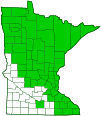
Distribution |
||||
|
Sources |
|||
| 3/24/2023 | ||||
Nativity |
||||
Native |
||||
Occurrence |
||||
Common and widespread |
||||
Taxonomy |
|||
| Kingdom | Plantae (Plants) | ||
| Subkingdom | Pteridobiotina | ||
| Phylum | Tracheophyta (Vascular Plants) | ||
| Subdivision | Polypodiophytina | ||
| Class | Polypodiopsida (ferns) | ||
| Subclass | Polypodiidae (leptosporangiate ferns) | ||
Order |
Polypodiales | ||
| Suborder | Dennstaedtiineae | ||
Family |
Dennstaedtiaceae (bracken) | ||
Genus |
Pteridium (brackens) | ||
| Species | Pteridium aquilinum (western bracken fern) | ||
Most sources list western bracken fern as a variety, Pteridium aquilinum var. latiusculum. ITIS and NCBI list it a subspecies,Pteridium aquilinum ssp. latiusculum. |
|||
Subordinate Taxa |
|||
There are four varieties of Pteridium aquilinum. This is the only variety that occurs in Minnesota. |
|||
Synonyms |
|||
Pteridium aquilinum var. champlainense Pteridium aquilinum ssp. latiusculum Pteridium latiusculum |
|||
Common Names |
|||
common bracken eagle fern western bracken fern western brackenfern |
|||
Glossary
Costa
The central axis of a pinna, to which pinnules are attached.
Costule
The midrib of a pinnule.
Frond
A large leaf with many divisions: in ferns, the compound leaf, including the stipe and the blade; in mosses, a closely and regularly branched stem resembling a fern leaf; in lichens, a stalkless, leaf-like extension.
Indusium
Undergarment. In ferns: A veil covering the cluster (sorus) of spore-producing structures (sporangia). In fungi: A skirt-like structure hanging from the cap (receptacle) of a stinkhorn.
Linear
Long, straight, and narrow, with more or less parallel sides, like a blade of grass.
Pinna
The primary division of a compound leaf or fern frond.
Pinnate
On a compound leaf, having the leaflets arranged on opposite sides of a common stalk. On a bryophyte, having branches evenly arranged on opposite sides of a stem.
Pinnule
The ultimate segment (individual leaflets) of a twice or more compound leaf or fern frond.
Rachis
The main axis of a compound leaf, appearing as an extension of the leaf stalk; the main axis of an inflorescence.
Reflexed
Bent backward.
Rhizome
A horizontal, usually underground stem. It serves as a reproductive structure, producing roots below and shoots above at the nodes.
Sorus
A compact cluster of spore-bearing cases or sacs (sporangia) on a fern.
Sporangium
A spore bearing structure, as of a fern or moss.
Stipe
A supporting stalk-like structure lacking vascular tissue: in fungi, the stalk supporting the mushroom cap; in ferns, the stalk connecting the blade to the rhizome; in flowering plants, the stalk connecting the flower’s ovary to the receptacle; in orchids; the band connecting the pollina with the viscidium.
Visitor Photos |
|||||
Share your photo of this plant. |
|||||
| This button not working for you? Simply email us at info@MinnesotaSeasons.com. Attach one or more photos and, if you like, a caption. |
|||||
|
|||||
MinnesotaSeasons.com Photos |
|||||
Plant |
|||||
 |
 |
||||
 |
 |
||||
Frond |
|||||
 |
|
||||
Pinnae |
|||||
 |
 |
||||
 |
|||||
Pinnules |
|||||
 |
 |
||||
Ultimate Segments |
|||||
 |
|||||
Underside |
|||||
 |
|||||

Slideshows |
||
| Bracken Fern (Pteridium aquilinum) Andree Reno Sanborn |
||
|
||
Visitor Videos |
|||
Share your video of this plant. |
|||
| This button not working for you? Simply email us at info@MinnesotaSeasons.com. Attach a video, a YouTube link, or a cloud storage link. |
|||
Other Videos |
|||
| Bracken Fern.mp4 Darryl Patton |
|||
About
Uploaded on Jun 28, 2010 Bracken Ferns have had a long history of being used in herbal medicine for a variety of conditions such as worms. They are however, too toxic for the average person to experiment with until they have gained a great deal of experience. Improper usage will cause internal bleeding. |
|||
| 2 Bracken Fern and life cycle.wmv PalmettoMan Adventures |
|||
About
Uploaded on Oct 13, 2011 New River State Park Wagonr Access Fern Nature Trail 2 miles. |
|||
| Bush tucker - Eating bracken fern James Neill |
|||
About
Uploaded on Mar 7, 2010 Jimee shows the kids how to eat fern (one way). |
|||
| Common Bracken (Pteridium aquilinum) - 2012-05-05 W3stlander |
|||
About
Published on May 7, 2012 Pteridium aquilinum (bracken or common bracken) is a species of fern occurring in temperate and subtropical regions throughout much of the northern hemisphere. ----------------- De adelaarsvaren (Pteridium aquilinum) is een varen uit de adelaarsvarenfamilie (Dennstaedtiaceae). |
|||
| HW Plant Challenge 2 Uses of Bracken Fern luvhambo |
|||
About
Published on Jul 17, 2013 The challenge is to show two uses of an herbaceous plant. These are two that I haven't seen done before. Hope you enjoy. |
|||

Visitor Sightings |
|||||
Report a sighting of this plant. |
|||||
| This button not working for you? Simply email us at info@MinnesotaSeasons.com. Be sure to include a location. |
|||||
|
|||||
MinnesotaSeasons.com Sightings |
|||||
|
Created: Last Updated: © MinnesotaSeasons.com. All rights reserved. |