



western ragweed
(Ambrosia psilostachya)
Conservation • Wetland • Description • Habitat • Ecology • Use • Distribution • Taxonomy
Conservation Status |
|
|||||||
| IUCN Red List | not listed |
|||||||
| NatureServe | N4N5 - Apparently Secure to Secure SNR - Unranked |
|||||||
| Minnesota | not listed |
|||||||
Wetland Indicator Status |
||||||||
| Great Plains | FACU - Facultative upland |
|||||||
| Midwest | FACU - Facultative upland |
|||||||
| Northcentral & Northeast | FAC - Facultative |
|||||||
Description |
||
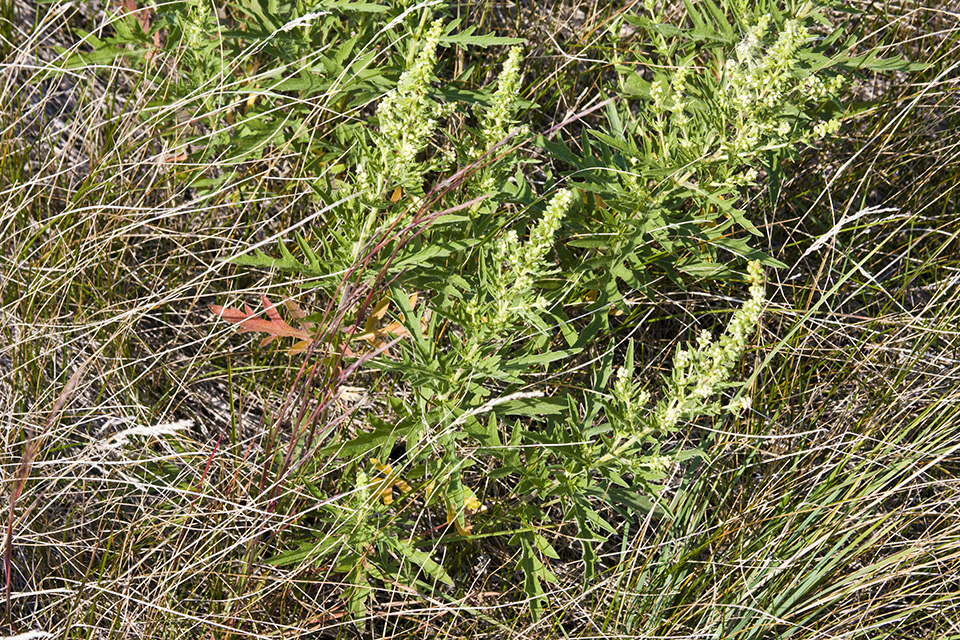
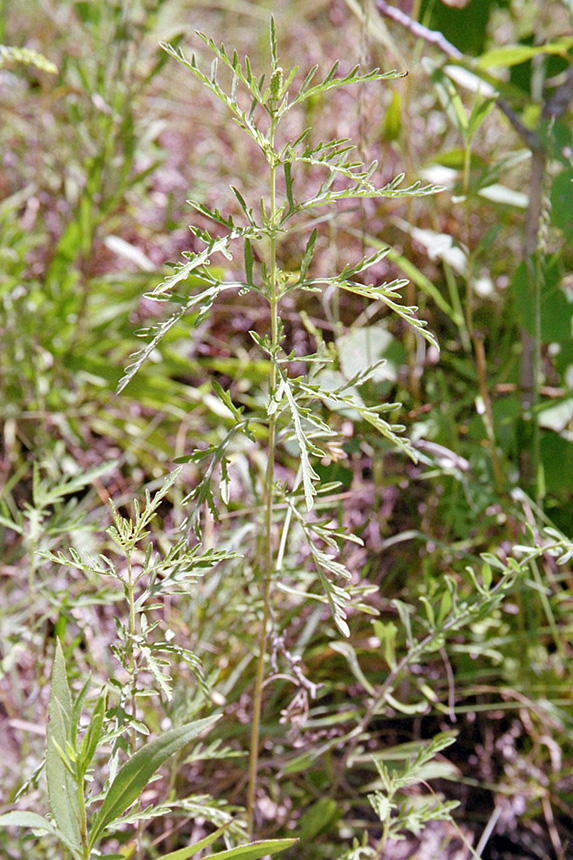
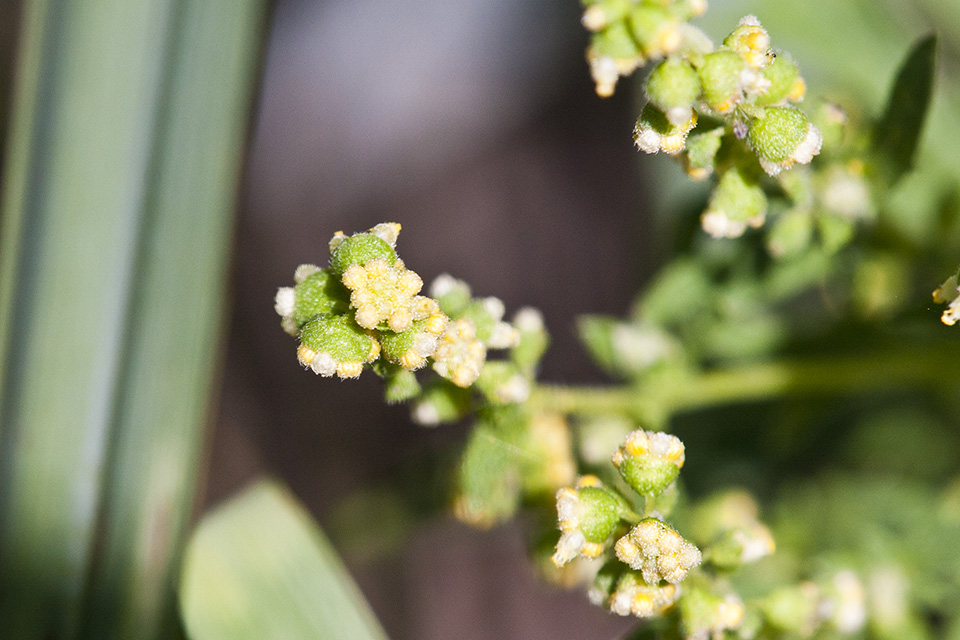
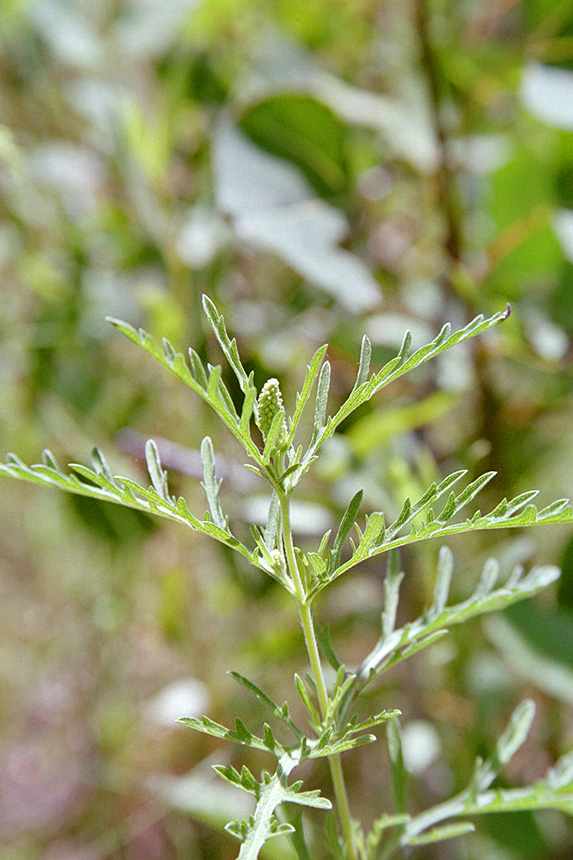
Western ragweed is a 12″ to 40″, usually 12″ to 24″ tall, erect, perennial forb that rises from creeping, fibrous roots and rhizomes. It is colonial, often forming dense patches. The root system releases chemical toxins that inhibit the growth or germination of nearby competing plants (allelopathy). The stems are erect, bushy, branched at least above the middle, and covered with white hairs. Leaves are opposite near the base, alternate above. They are narrow and once pinnatifid, the lobes deep, widely spaced, and bluntly pointed. They are ¾″ to 5½″ long, usually no longer than 2⅓″, and ⅓″ to 2″ wide, usually no wider than 1⅓″. The upper and lower surfaces are rough to the touch, gland-dotted, and covered with stiff hairs that are either straight or appressed. The leaves near the base are on stalks up to 1″ long, the stalks progressively shorter as they ascend the stem. Upper leaves are attached to the stem without stalks. There are separate male and female flowers, both borne on the same plant. Male flowers are borne in spike-like inflorescences at the ends of stems and branches. The spikes are up to 4″ long with 5 to 30, usually 5 to 15 flower heads. The heads are green, bead-like, and about ⅛″ in diameter. They hang downward at the end of short stalks. Female flowers appear singly from upper leaf axles. Both flowers are rayless and have no floral scent. The fruit is an achene without tufts of hair. |
||
Height |
||
12″ to 40″, usually 12″ to 24″ |
||
Flower Color |
||
Green |
||
Similar Species |
||
Common ragweed (Ambrosia artemisiifolia) leaves are bipinnatifid (twice cut), not pinnatifid (once cut). Giant ragweed (Ambrosia trifida) is a much taller plant. Its leaves are palmately lobed. Lance-leaved ragweed (Ambrosia bidenta) leaves, as the latin name suggests, have two teeth, one on each side of the leaf. It has been recorded only in Ramsey County. Annual bursage (Ambrosia acanthicarpa) leaves are bipinnatifid and are covered with white to gray, short, bristly hairs. |
||
Habitat |
||
Dry. Prairies, disturbed sites. |
||
Ecology |
||
Flowering |
||
August to September |
||
Pests and Diseases |
||
Olive-shaded bird-dropping moth (Ponometia candefacta) larvae feed on the foliage. |
||
Use |
||
|
||
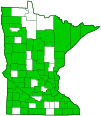
Distribution |
||||
|
Sources |
|||
| 3/30/2023 | ||||
Nativity |
||||
Native |
||||
Occurrence |
||||
|
||||
Taxonomy |
|||
| Kingdom | Plantae (Plants) | ||
| Subkingdom | Pteridobiotina | ||
| Phylum | Tracheophyta (Vascular Plants) | ||
| Class | Magnoliopsida (Dicots) | ||
Order |
Asterales (Sunflowers, Bellflowers, Fanflowers, and Allies) | ||
Family |
Asteraceae (Sunflowers, Daisies, Asters, and Allies) | ||
| Subfamily | Asteroideae | ||
| Tribe | Heliantheae (Sunflowers and Allies) | ||
| Subtribe | Ambrosiinae (cockleburs, ragweeds, and wild quinines) | ||
| Genus | Ambrosia (ragweeds) | ||
Subordinate Taxa |
|||
|
|||
Synonyms |
|||
Ambrosia californica Ambrosia coronopifolia Ambrosia cumanensis Ambrosia psilostachya var. californica Ambrosia psilostachya var. coronopifolia Ambrosia psilostachya var. lindheimeriana Ambrosia rugelii |
|||
Common Names |
|||
cuman ragweed naked-spiked ragweed perennial ragweed western ragweed |
|||
Glossary
Achene
A dry, one-chambered, single-seeded seed capsule, formed from a single carpel, with the seed attached to the membranous outer layer (wall) only by the seed stalk; the wall, formed entirely from the wall of the superior ovary, does not split open at maturity, but relies on decay or predation to release the contents.
Allelopathy
The release of a chemical toxin by one plant to inhibit the growth or germination of nearby competing plants.
Axil
The upper angle where the leaf stalk meets the stem.
Bipinnatifid
Twice pinnatifid. Cut deeply into lobes with each lobe also cut into deep lobes.
Palmately Lobed
Similar to a hand. Having more than three lobes that radiate from a single point at the base of the leaf.
Pinnatifid
Deeply cut, more than half way to the midrib but not to the midrib, into lobes that are spaced out along the midrib; the lobes do not form separate leaflets.
Rhizome
A horizontal, usually underground stem. It serves as a reproductive structure, producing roots below and shoots above at the nodes.
Visitor Photos |
|||||
Share your photo of this plant. |
|||||
| This button not working for you? Simply email us at info@MinnesotaSeasons.com. Attach one or more photos and, if you like, a caption. |
|||||
|
|||||
MinnesotaSeasons.com Photos |
|||||
Plant |
|||||
 |
 |
||||
Inflorescence |
|||||
 |
 |
||||
Leaves |
|||||
 |
 |
||||

Slideshows |
||
Visitor Videos |
|||
Share your video of this plant. |
|||
| This button not working for you? Simply email us at info@MinnesotaSeasons.com. Attach a video, a YouTube link, or a cloud storage link. |
|||
Other Videos |
|||
| WESTERN RAGWEED naturebytesvideo |
|||
About
Uploaded on Aug 23, 2011 A sunflower member with a small heat of disk florets. Common along roads. |
|||

Visitor Sightings |
|||||
Report a sighting of this plant. |
|||||
| This button not working for you? Simply email us at info@MinnesotaSeasons.com. Be sure to include a location. |
|||||
|
|||||
MinnesotaSeasons.com Sightings |
|||||
Badoura Jack Pine Woodland SNA Blazing Star Prairie Addition Preserve, South Unit Felton Prairie SNA, Bicentennial Unit Kellogg Weaver Dunes SNA, Kellogg Weaver Unit Margherita Preserve-Audubon Prairie Mound Spring Prairie SNA, North Unit Mound Spring Prairie SNA, South Unit Northern Tallgrass Prairie NWR, Hoffman Unit Northern Tallgrass Prairie NWR, Pavia Unit Northern Tallgrass Prairie NWR, Rengstorf Unit Northern Tallgrass Prairie NWR, Spieker Unit Pankratz Memorial Prairie, North Unit Pembina Trail Preserve SNA, Pembina Trail Unit Prairie Creek WMA, Koester Prairie Unit Richard M. & Mathilde Rice Elliott SNA Sand Prairie Wildlife Management and Environmental Education Area |
|||||
|
Created: Last Updated: © MinnesotaSeasons.com. All rights reserved. |