northern red oak - Species Profile
Conservation • Wetland • Description • Habitat • Ecology • Use • Distribution • Taxonomy

Conservation Status
IUCN Red List
not listed
NatureServe
N5 - Secure
SNR - Unranked
Minnesota
not listed
Wetland Indicator Status
Great Plains
FACU - Facultative upland
Midwest
FACU - Facultative upland
Northcentral & Northeast
FACU - Facultative upland
Description
Northern red oak is a fast growing, deciduous tree rising on a single trunk from a deep, spreading root system. When it is on deep soils it develops a taproot. It is moderately long-lived, often surviving 300 or more years. In Minnesota mature trees are usually 60′ to 70′ tall and 36″ to 42″ in diameter, though individuals can reach over 110′ in height.
In open areas the trunk is short and massive and the crown is extensive, broad, round, and symmetrical. Where it has competition the trunk is long and straight and the crown is small, and round. The branches are stout and widely spreading.
The bark on young trees is gray to reddish brown, smooth, and somewhat shiny. On mature trees the bark is thick and dark gray or grayish-brown. It is broken into long, smooth, flat-topped, pale gray ridges separated by shallow, dark furrows. The long, pale gray ridges have the appearance of ski trails.
Young twigs are slender, bright green, and shiny. As they age they become moderately stout and reddish-brown.
Terminal buds are reddish-brown, shiny, egg-shaped, pointed, round in cross section, and ¼″ to 5 ⁄16″ long. The scales near the tip may have a few brownish, silky hairs at the tip but the buds are otherwise hairless. They are surrounded by a cluster of lateral buds.
The leaves are alternate, egg-shaped, inversely egg-shaped, or elliptic in outline, 4″ to 7″ long, and 3″ to 5½″ wide. They are on hairless, ¾″ to 2″ long leaf stalks that are yellowish with a tinge of red, often mostly red with yellow at the base. The leaf blade is broadly tapered or nearly squared off at the base. There are 2 to 4 large primary lobes separated by U-shaped sinuses and 5 to 18 smaller, bristle-tipped, secondary lobes per side. Most of the sinuses extend less than half way to the midrib. The deepest sinuses extend 45% to 70% of the way to the midrib. The upper surface is dark green, dull, and hairless. The lower surface is yellowish-green or grayish, hairless except for minute tufts of hair in the vein axils, and sometimes covered with a whitish, waxy bloom (glaucous). Young leaves are toothed, not lobed, and are pink and downy when unfurling. In autumn the leaves turn scarlet or deep red, then brown. The name of this tree refers to the color of the autumn foliage.
Male and female flowers are borne on the same branch. Male flowers are in slender, greenish, 1½″ to 3½″ long catkins that hang downward from buds on branchlets of the previous year. Female flowers are bright green and appear singly or in pairs on a short stalk rising from leaf axils on branchlets of the current year. The flowers appear after the leaves in early May to late May.
The fruit is a broadly egg-shaped, ⅝″ to 1″ long, ½″ to ⅞″ wide acorn. They occur singly or in pairs on a short, stout stalk. A shallow, scaly, saucer-shaped cup encloses 1 ⁄5 to ¼, sometimes to ⅓, of the lower part of the nut. The cup resembles a beret that barely covers the bottom of the nut. The scales on the cup are flat and the tips of the scales are tightly appressed. The inside of the acorn cup is hairless or has a few scattered hairs. The acorns stay on the tree for two growing seasons. The kernel is white and tastes very bitter. It ripens in mid-August to mid-September of the second year. This is the largest acorn of the oaks found in Minnesota.
Height
60′ to 70′
Record
The champion northern red oak in Minnesota is on private property near the city of Spring Grove, in Houston County. In 1988 it was measured at 75′ tall and 191″ in circumference (61″ in diameter), with a crown spread of 66′.
Flower Color
Green
Similar Species
Black oak (Quercus velutina) leaves have 2 or 3 primary lobes per side. The acorn is smaller, no more than ¾″ long. The tips of the acorn cup scales are free, not tightly appressed. In Minnesota it is found only in the southeast and in Hennepin County.
Northern pin oak (Quercus ellipsoidalis) has mature bark broken into short, rough, slightly blocky ridges. Terminal buds much smaller and are 5-angled in cross section, not round. The leaf blades are more deeply lobed. Most of the sinuses extend more than half way to the midrib. The deepest sinuses extend 65% to 90% of the way to the midrib. The upper leaf surface is dull. The acorn is smaller, no more than ⅝″ long. The kernel is yellow.
Habitat
Moderate moisture. Hardwood forests. Moderately shade tolerant when young.
Ecology
Flowering
Early May to late May
Pests and Diseases
Oak leaf gall midge (Polystepha pilulae)
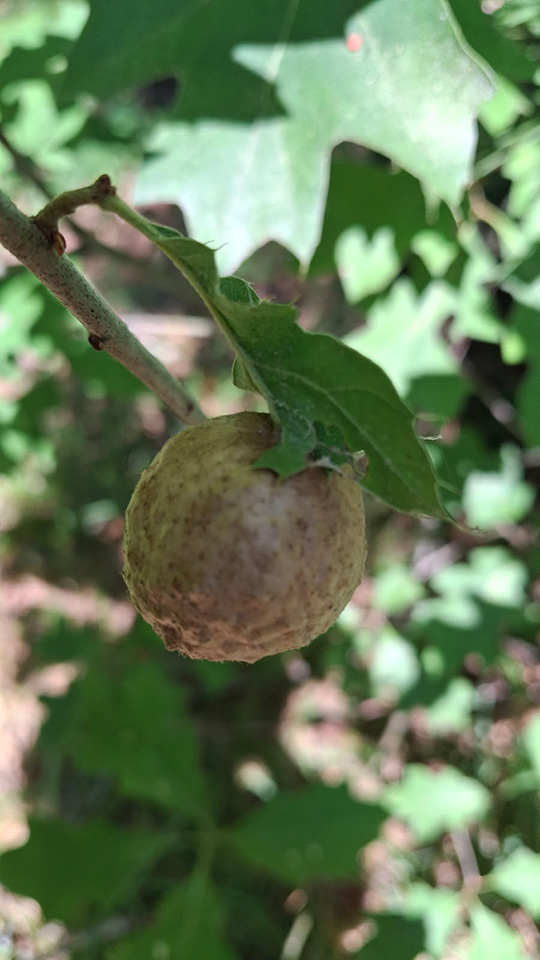
Spongy oak apple gall wasp (Amphibolips confluenta)
Tubakia leaf spot (Tubakia dryina) causes brown or reddish-brown spots on the leaves of all oaks but especially those in the red oak group. It starts in early summer as small, brown, angular spots with a pale center.
Use
This is the state tree of New Jersey and the provincial tree of Prince Edward Island.
Distribution

Sources
Biodiversity occurrence data published by: Minnesota Biodiversity Atlas (accessed through the Minnesota Biodiversity Atlas Portal, bellatlas.umn.edu. Accessed 7/27/2026).
Midwest Herbaria Portal. 2026. https://midwestherbaria.org/portal/index.php. Accessed 7/27/2026.
Quercus rubra L. in Bánki, O., Roskov, Y., Döring, M., Ower, G., Hernández Robles, D. R., Plata Corredor, C. A., Stjernegaard Jeppesen, T., Örn, A., Pape, T., Hobern, D., Garnett, S., Little, H., DeWalt, R. E., Miller, J., Orrell, T., Aalbu, R., Abbott, J., Abreu, C., Acero P, A., et al. (2026). Catalogue of Life (2026-07-17 XR). Catalogue of Life Foundation, Amsterdam, Netherlands. https://doi.org/10.48580/dgykv
Smith, Welby R. 2008. Trees and Shrubs of Minnesota: The Complete Guide to Species Identification. The University of Minnesota Press, Minneapolis, MN.
Nativity
Native
Occurrence
Common
Taxonomy
Kingdom
Subkingdom
Pteridobiotina
Phylum
Tracheophyta (Vascular Plants)
Class
Order
Fagales (Beeches, Oaks, Walnuts, and Allies)
Family
Fagaceae (Beech)
Subfamily
Fagoideae
Genus
Quercus (Oaks)
Subgenus
Quercus (High-latitude Oaks)
Section
Lobatae (Red Oaks)
Subsection
Coccineae
Subordinate Taxa
Synonyms
Erythrobalanus rubra
Quercus acerifolia
Quercus ambigua
Quercus angulizana
Quercus borealis
Quercus borealis var. flabellata
Quercus borealis var. maxima
Quercus coccinea var. ambigua
Quercus cuneata
Quercus maxima
Quercus michauxii
Quercus rubra var. ambigua
Quercus rubra var. borealis
Quercus rubra var. hispanica
Quercus rubra var. latepinnatifida
Quercus rubra var. latifolia
Quercus rubra var. maxima
Quercus rubra var. pendula
Quercus rubra var. ramosissima
Quercus rubra var. rubra
Quercus rubra var. subserrata
Quercus sada
Common Names
American red oak
black oak
buck oak
Canadian red oak
common red oak
gray oak
eastern red oak
leopard oak
Maine red oak
mountain red oak
northern red oak
red oak
Spanish oak
spotted oak
southern red oak
swamp red oak
water oak
West Virginia soft red oak