smooth sumac - Species Profile
Conservation • Description • Habitat • Ecology • Use • Distribution • Taxonomy
Conservation Status
IUCN Red List
not listed
NatureServe
N5 - Secure
SNR - Unranked
Minnesota
not listed
Description
Smooth sumac is a fast-growing, 4′ to 15′ tall shrub or, rarely, small tree. It rises on a single trunk from long-creeping branched rhizomes. In Minnesota mature plants are usually 4′ to 15′ tall and 2″ to 4″ in diameter. Large individuals can reach over 32′ in height and 8″ in diameter. It often forms dense colonies with the oldest and tallest individuals in the center surrounded by progressively younger and shorter individuals. It is a short-lived tree, usually surviving no more than 50 years.
The trunk is forked and occasionally branched. The crown is open, irregular, and rounded or flat-topped.
The bark on young parts is thin, smooth, and dark brown to yellowish-brown with prominent lenticels. As it ages it becomes slightly scaly.
The upper branchlets are hairless, but flowering branches are sparsely hairy. The lower trunk and branches are hairless and woody.
The twigs are very stout, tan to slightly reddish, and hairless. Older branches have prominent lenticels, while younger branches and twigs do not. When broken the branches exude a yellowish sap.
There is no terminal bud—the branches end in a cluster of fruits or a dead stub. The lateral buds are cone-shaped, 3 ⁄16″ to ¼″ long, and covered with pale brown, velvety hairs. The leaf scar is crescent or horse-shoe shaped and has 3 bundle scars. The leaf scar almost completely surrounds the bud.
The leaves are deciduous, alternate, and pinnately compound. They are 12″ to 24″ long and are divided into 11 to 31 leaflets. They are on 1¼″ to 4″ long, hairless leaf stalks. The central stalk of the leaf to which the leaflets are attached is slightly reddish and hairless and is not winged.
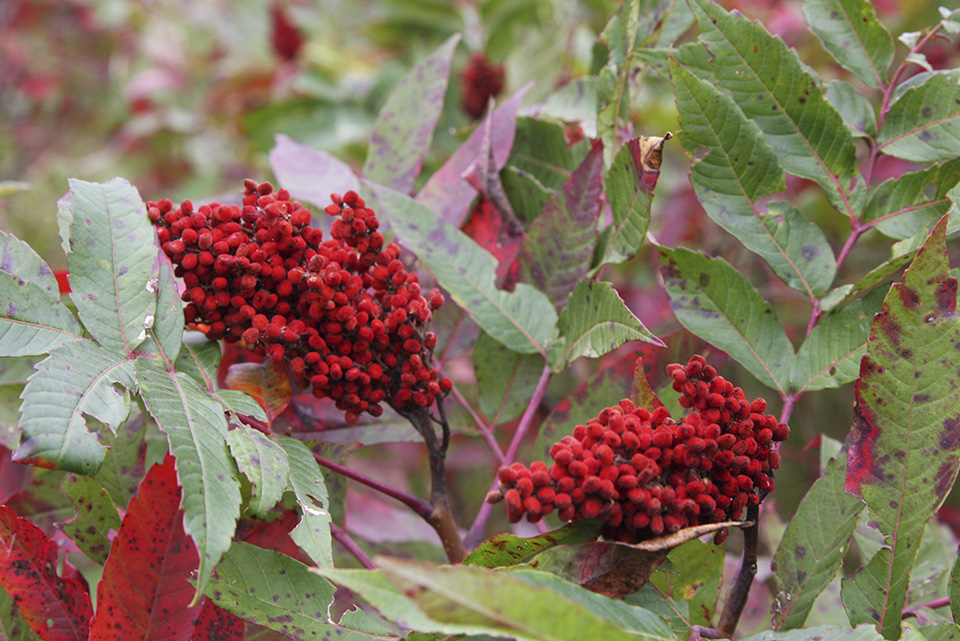
The leaflets are stalkless or on very short stalks. They are arranged in opposite or slightly alternate pairs with 1 terminal leaflet. They are lance-shaped, 2″ to 4¾″ long, and ¾″ to 1¾″ wide. They are rounded or slightly heart-shaped at the base and taper to a long point at the tip. The upper surface is dark green and hairless. The lower surface is pale green to sometimes nearly white, hairless, and covered with a whitish, waxy coating (glaucous). The margins have fine, sharp, forward-pointing teeth or are rarely pinnately lobed. In autumn the leaves turn bright orange, red, or purple.
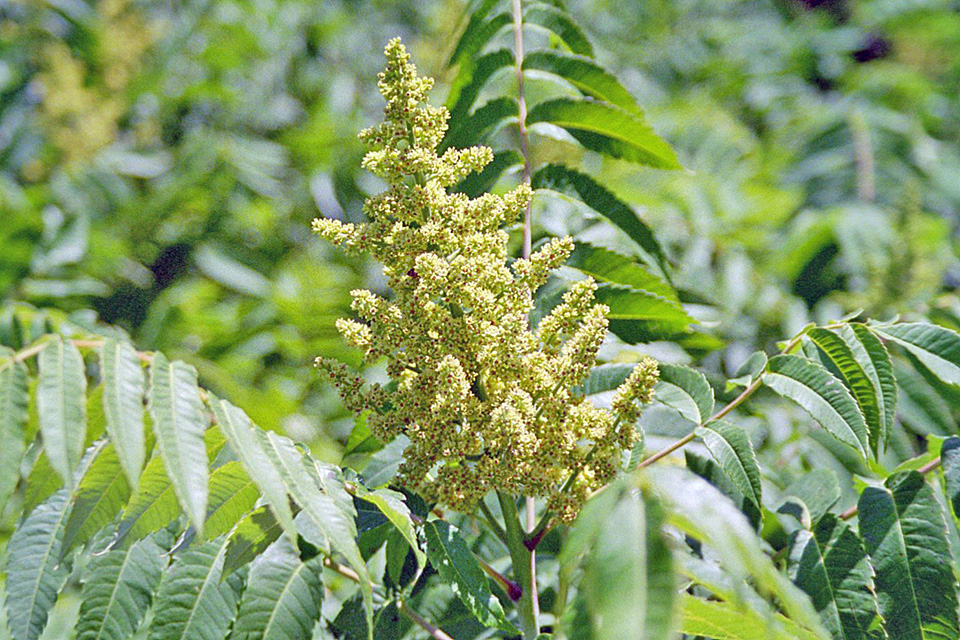
Male and female flowers are borne on separate plants. The inflorescence is a dense, erect, 2¾″ to 10″ long, 1½″ to 2″ wide, branched cluster (panicle) at the end of many of the branchlets. Each panicle is made up of 100 to 700 flowers. Female panicles are more compact than male panicles.
The flowers are tiny and yellowish-green. They appear in early June to mid-July after the leaves are fully developed.
The fruit is fleshy and surrounds a single seed (drupe). It is dark red, ⅛″ to 3 ⁄16″ long and wide, and covered with bright red, needle-like hairs. They are held in dense, upright clusters. They ripen from August to September and persist for most of the winter.
Height
4′ to 15′
Flower Color
Yellowish-green
Similar Species
Staghorn sumac (Rhus typhina) branches, twigs, and rachis are densely covered with short, woolly or felty hairs. The drupes are densely hairy. It is less common than smooth sumac.
Habitat
Dry. Abandoned fields, forest edges, thickets, roadsides. Full sun.
Ecology
Flowering
Early June to mid-July
Pests and Diseases
Use
Distribution

Sources
Biodiversity occurrence data published by: Minnesota Biodiversity Atlas (accessed through the Minnesota Biodiversity Atlas Portal, bellatlas.umn.edu. Accessed 3/5/2026).
Midwest Herbaria Portal. 2026. https://midwestherbaria.org/portal/index.php. Accessed 3/5/2026.
Rhus glabra L. in GBIF Secretariat (2023). GBIF Backbone Taxonomy. Checklist dataset https://doi.org/10.15468/39omei accessed via GBIF.org. Accessed 3/5/2026.
Smith, Welby R. 2008. Trees and Shrubs of Minnesota: The Complete Guide to Species Identification. The University of Minnesota Press, Minneapolis, MN.
Nativity
Native
Occurrence
Common
Taxonomy
Kingdom
Subkingdom
Pteridobiotina
Phylum
Tracheophyta (Vascular Plants)
Class
Order
Sapindales (Soapberries, Cashews, Mahoganies, and Allies)
Family
Anacardiaceae (Cashew)
Tribe
Rhoeae
Genus
Rhus (Sumacs)
Subordinate Taxa
Synonyms
Rhus albida
Rhus angustiarum
Rhus aprica
Rhus arbuscula
Rhus arguta
Rhus asplenifolia
Rhus atrovirens
Rhus auriculata
Rhus borealis
Rhus calophylla
Rhus carolinense
Rhus carolinensis
Rhus caroliniana
Rhus cismontana
Rhus cismontana var. flavescens
Rhus coccinea
Rhus elegans
Rhus elegans var. glauca
Rhus elegans var. superba
Rhus elegantula
Rhus glabra var. borealis
Rhus glabra var. canadensis
Rhus glabra var. carolinensis
Rhus glabra var. cismontana
Rhus glabra var. cismontana
Rhus glabra var. coccinea
Rhus glabra var. dioica
Rhus glabra var. elegans
Rhus glabra var. glabra
Rhus glabra var. hermaphrodita
Rhus glabra var. laciniata
Rhus glabra var. occidentalis
Rhus glabra var. sandbergii
Rhus hapemanii
Rhus ithacensis
Rhus laevicaulis
Rhus laevicaulis
Rhus longula
Rhus ludoviciana
Rhus macrothyrsa
Rhus media
Rhus nitens
Rhus occidentalis
Rhus oreophila
Rhus petiolata
Rhus pulchella
Rhus pyramidata
Rhus sambucina
Rhus sandbergii
Rhus sanguinea
Rhus sorbifolia
Rhus tessellata
Rhus valida
Rhus viridiflora
Schmaltzia glabra
Toxicodendron glabrum
Turpinia glabra
Common Names
smooth sumac