common evening primrose - Species Profile
Conservation • Wetland • Description • Habitat • Ecology • Use • Distribution • Taxonomy

Conservation Status
IUCN Red List
not listed
NatureServe
N5 - Secure
SNR - Unranked
Minnesota
not listed
Wetland Indicator Status
Great Plains
FACU - Facultative upland
Midwest
FACU - Facultative upland
Northcentral & Northeast
FACU - Facultative upland
Description
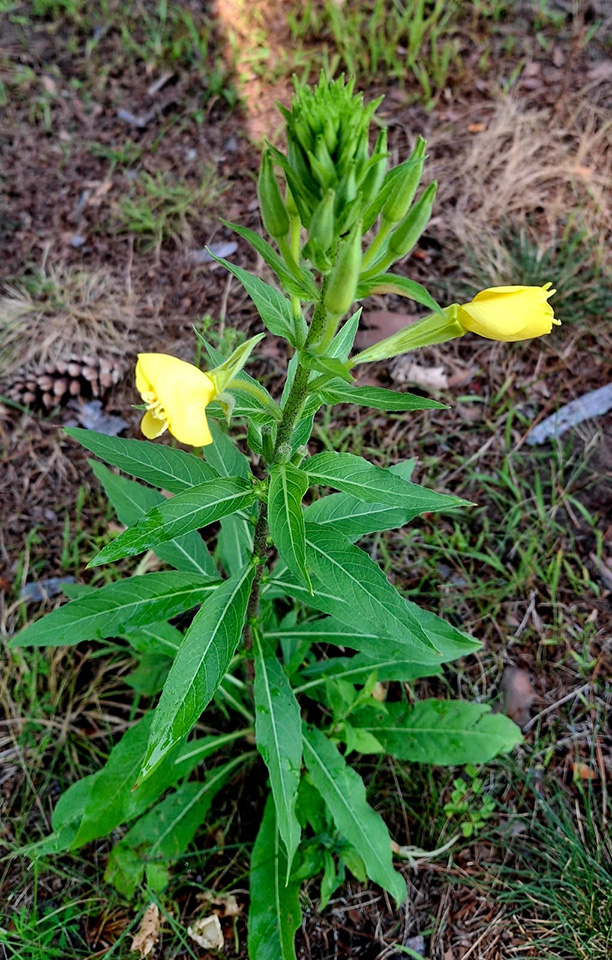
Common evening primrose is an erect, biennial forb that rises usually on a single stem from a fleshy taproot. It can be up to 80″ tall, though it is usually much shorter. In the first year it forms a rosette of basal leaves. In the second year it sends up a flowering stem. It dies after bearing fruit once.
The rosette leaves are green to pale green, stalked, narrowly inversely lance-shaped or lance-shaped, 4″ to 12″ long, and ¾″ to 2″ wide. The blade is broadly or narrowly angled at the tip and tapers gradually to the leaf stalk at the base. The upper and lower surfaces are covered with minute, straight, sharp, stiff, appressed hairs. The margin is toothed. The teeth are sometimes blunt, sometimes widely spaced. The lower part of the blade sometimes has broad, wavy teeth or is lobed.
The stem is erect, green, leafy, and sometimes flushed with red near the base. It may be unbranched or have a few branches rising from the rosette or a few branches on the main stem. It is densely to sparsely covered with minute, straight, sharp, stiff, appressed hairs, and also with longer, somewhat appressed to spreading hairs.
Stem leaves are alternate, narrowly inversely lance-shaped to lance-shaped or narrowly elliptic to elliptic, 2″ to 8½″ long, and ⅝″ to 2″ wide. The blade is narrowly angled at the tip and wedge-shaped or tapered at the base. They are otherwise similar to rosette leaves. There is often a cluster of smaller, secondary leaves in the axil of the leaf.
The inflorescence is a stiff, relatively open spike of numerous flowers at the end of the stem and branches. The spike is unbranched but there is often a secondary spike below the main one. The central axis of the spike (rachis) sometimes red. It is densely to sparsely covered with minute, straight, sharp, stiff, appressed hairs, and also with longer, somewhat appressed to spreading hairs.
The individual flowers are stalkless. What appears to be a stalk is, in fact, an elongated ovary surmounted by a hypanthium, a floral tube formed by the fused bases of the sepals, petals, and stamens. The floral tube is yellowish-green, sometimes flushed with red. It is sparsely to densely covered with short, straight, glandular hairs and also sparsely covered with long, soft, shaggy hairs. When in bud it is 1″ to 1 9 ⁄16″ long, 1 ⁄32″to 1⁄16″ in diameter, widely spreading near the rachis then strongly ascending, with the bud held upright. When in bloom the floral tube elongates, straightens somewhat, and the flower is held at about a 45° angle.
The flowers are crowded and 1″ to 2″ in diameter when fully open. There are 4 sepals, 4 petals, 8 stamens, and 1 style. The sepals are yellowish-green, linear, ½″ to ⅞″ long, and strongly bent backward along the hypanthium. The petals are yellow, rarely pale yellow, very broadly egg-shaped, ½″ to 1″ long, and 9 ⁄16″ to 1 1 ⁄16″ wide. They are broadly rounded and notched at the tip. They fade to orange as they begin to wither. The stamens extend only slightly beyond the corolla. They have 5 ⁄16″ to ⅝″ long filaments and ⅛″ to ¼″ long anthers. The style has a distinctive, 4-lobed, cross-shaped stigma. The flowers open around sunset and close by noon except on cloudy days, when they remain open. They change from closed to fully open in just one minute. They are pollinated by hawk moths or sphinx moths, which feed on their nectar at night. The hypanthium, petals, and sepals are deciduous, withering and falling off when the fruit is formed. The flowers have a mild lemony scent.
The fruit is a cylinder-shaped, ¾″ to 1 9 ⁄16″ long, ⅛″ to ¼″ in diameter, 4-celled capsule. The capsule is green, stalkless; bluntly 4-angled with rounded angles; thickest at the base and tapered toward the tip; and straight, not curved near the base. Each cell of the capsule contains two rows of dark brown, egg-shaped seeds. The seeds do not have a tuft of hairs (pappus) at the top.
Height
20″ to 80″
Flower Color
Yellow
Similar Species
Cleland’s evening primrose (Oenothera clelandii) is a smaller plant, no more than 40″ in height. The flowers are smaller and have diamond-shaped petals. The seed capsules are smaller and are curved.
Cut-leaved evening primrose (Oenothera laciniata) is a short plant, reaching only 18" at maturity. The leaves are lobed.
Hairy evening primrose (Oenothera villosa ssp. villosa)
Northern evening primrose (Oenothera parviflora) has smaller flowers, no more than one inch wide.
Nuttall’s evening primrose (Oenothera nuttallii) has white flowers.
Perennial evening primrose (Oenothera perennis) is a shorter plant, reaching only 24″ at maturity. It has smaller flowers, ⅓″ to ¾″ wide.
Rhombic evening primrose (Oenothera rhombipetala) flower has diamond-shaped petals.
Toothed evening primrose (Oenothera serrulata) is a much shorter plant, reaching only 24″ at maturity. It is usually found with clustered stems, which may be woody at the base. The leaves are toothed, and are linear or oblong and narrow.
Habitat
Dry to moderate moisture. Prairies, fields, thickets, roadsides, railroads, disturbed sites and waste places. Full sun.
Ecology
Flowering
June to October
Pests and Diseases
Use
Distribution

Sources
Biodiversity occurrence data published by: Minnesota Biodiversity Atlas (accessed through the Minnesota Biodiversity Atlas Portal, bellatlas.umn.edu. Accessed 8/4/2026).
Midwest Herbaria Portal. 2026. https://midwestherbaria.org/portal/index.php. Accessed 8/4/2026.
Oenothera biennis L. in Bánki, O., Roskov, Y., Döring, M., Ower, G., Hernández Robles, D. R., Plata Corredor, C. A., Stjernegaard Jeppesen, T., Örn, A., Pape, T., Hobern, D., Garnett, S., Little, H., DeWalt, R. E., Miller, J., Orrell, T., Aalbu, R., Abbott, J., Abreu, C., Acero P, A., et al. (2026). Catalogue of Life (2026-07-17 XR). Catalogue of Life Foundation, Amsterdam, Netherlands. https://doi.org/10.48580/dgykv
Nativity
Native
Occurrence
Common and widespread
Taxonomy
Kingdom
Subkingdom
Pteridobiotina
Phylum
Tracheophyta (Vascular Plants)
Class
Order
Myrtales (Myrtles, Evening Primroses, and Allies)
Family
Onagraceae (Evening Primrose)
Subfamily
Onagroideae
Tribe
Onagreae
Genus
Oenothera (Evening Primroses, Sundrops, and Beeblossoms)
Section
Oenothera
Subsection
Oenothera
Subordinate Taxa
Synonyms
Brunyera biennis
Oenothera beckeri
Oenothera biennis f. biennis
Oenothera biennis f. leptomeres
Oenothera biennis f. muricata
Oenothera biennis f. nanella
Oenothera biennis subf. latifolia
Oenothera biennis ssp. biennis
Oenothera biennis ssp. caeciarum
Oenothera biennis ssp. centralis
Oenothera biennis var. alba
Oenothera biennis var. angustifolia
Oenothera biennis var. biennis
Oenothera biennis var. brevihypanthialis
Oenothera biennis var. cantabrigiana
Oenothera biennis var. leptomeres
Oenothera biennis var. lutea
Oenothera biennis var. muricata
Oenothera biennis var. parviflora
Oenothera biennis var. pycnocarpa
Oenothera biennis var. rubricaulis
Oenothera biennis var. sulfurea
Oenothera biennis var. sulphurea
Oenothera biennis var. vulgaris
Oenothera brevicapsula
Oenothera chrysantha var. latifolia
Oenothera communis
Oenothera communis f. canescens
Oenothera communis var. biennis
Oenothera furca
Oenothera gaurodes var. brevicapsula
Oenothera gauroides
Oenothera gauroides var. brevicapsula
Oenothera glabra
Oenothera grandiflora var. tracyi
Oenothera grandifolia
Oenothera graveolens
Oenothera hirtella
Oenothera media
Oenothera muricata
Oenothera muricata var. latifolia
Oenothera muricata var. rhodoneura
Oenothera muricata var. rubricaulis
Oenothera novae-scotiae var. serratifolia
Oenothera numismatica
Oenothera paralamarckiana
Oenothera parviflora var. muricata
Oenothera pratincola
Oenothera pratincola f. typica
Oenothera pratincola var. numismatica
Oenothera pubescens
Oenothera purpurata
Oenothera pycnocarpa
Oenothera pycnocarpa var. cleistogama
Oenothera pycnocarpa var. parviflora
Oenothera pycnocarpa var. pycnocarpa
Oenothera reynoldsii
Oenothera reynoldsii f. semialta
Oenothera reynoldsii f. stream typica
Oenothera royfraseri
Oenothera rubiella
Oenothera rubiennis
Oenothera ruderalis
Oenothera sabulosa
Oenothera sackvillensis
Oenothera sackvillensis var. albiviridis
Oenothera sackvillensis var. royfraseri
Oenothera sackvillensis var. sackvillensis
Oenothera salicastrum
Oenothera shulliana
Oenothera stenomeres
Oenothera stenomeres f. typica
Oenothera suaveolens
Oenothera tracyi
Oenothera victorinii
Oenothera victorinii var. intermedia
Oenothera victorinii var. parviflora
Oenothera victorinii var. undulata
Oenothera victorinii var. victorinii
Onagra biennis
Onagra chrysantha var. latifolia
Onagra europaea
Onagra media
Onagra muricata
Onagra vulgaris
Onosuris acuminata
Pseudo-oenothera virginiana
Common Names
common evening primrose
common evening-primrose
evening star
evening primrose
evening-primrose
fever-plant
German rampion
German-rampion
hoary eveningprimrose
hog weed
king’s cure-all
weedy evening-primrose