



narrow-leaved cattail
(Typha angustifolia)
Conservation • Weed • Wetland • Description • Habitat • Ecology • Use • Distribution • Taxonomy
Conservation Status |
|
|||||||
| IUCN Red List | LC - Least Concern |
|||||||
| NatureServe | NNR - Unranked SNR - Unranked |
|||||||
| Minnesota | not listed |
|||||||
Weed Status |
||||||||
Though narrow-leaved cattail is a native to Minnesota, some people consider it an invasive species. They argue that where it is introduced it soon crowds out other native species, often creating a monoculture. The Minnesota Department of Agriculture does not consider this an invasive species. |
||||||||
Wetland Indicator Status |
||||||||
| Great Plains | OBL - Obligate wetland |
|||||||
| Midwest | OBL - Obligate wetland |
|||||||
| Northcentral & Northeast | OBL - Obligate wetland |
|||||||
Description |
||
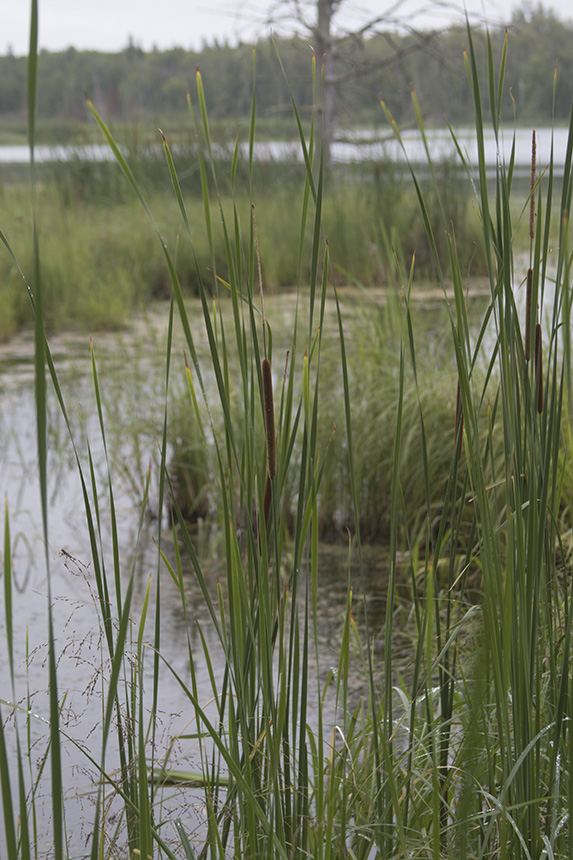
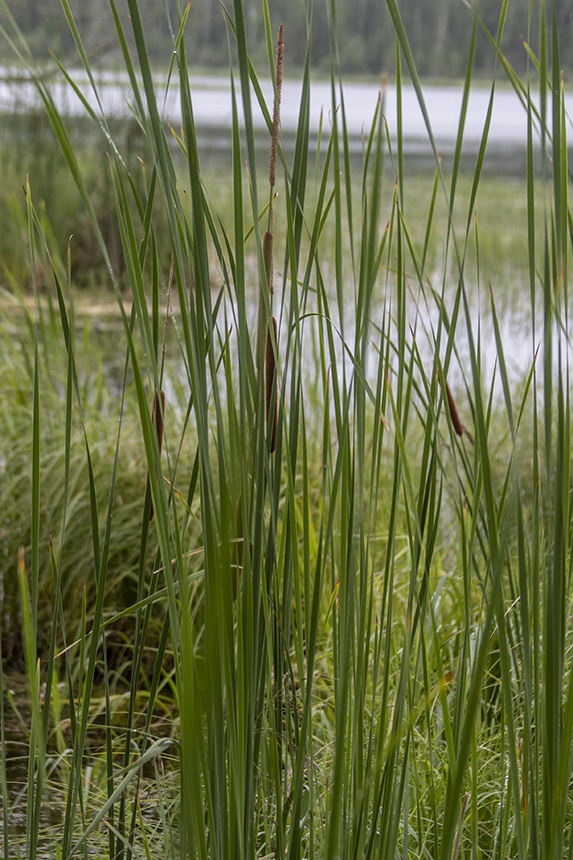
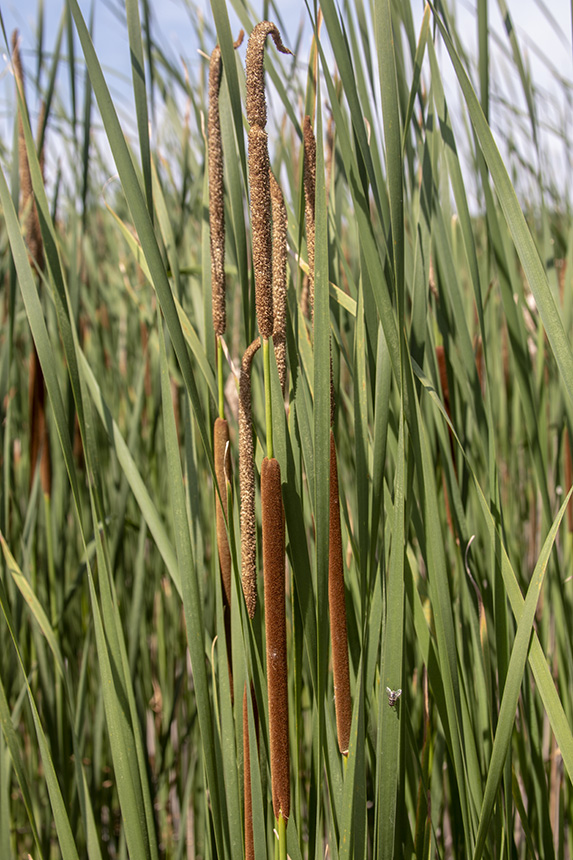
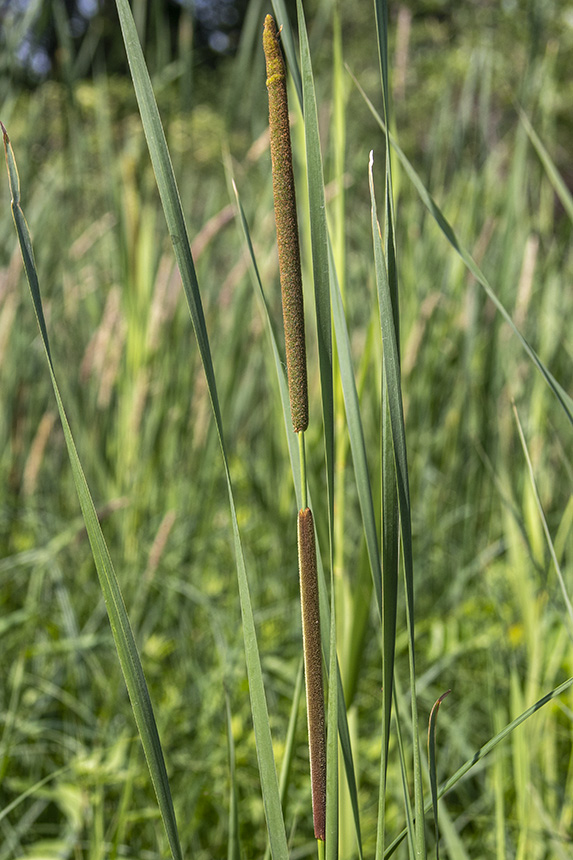
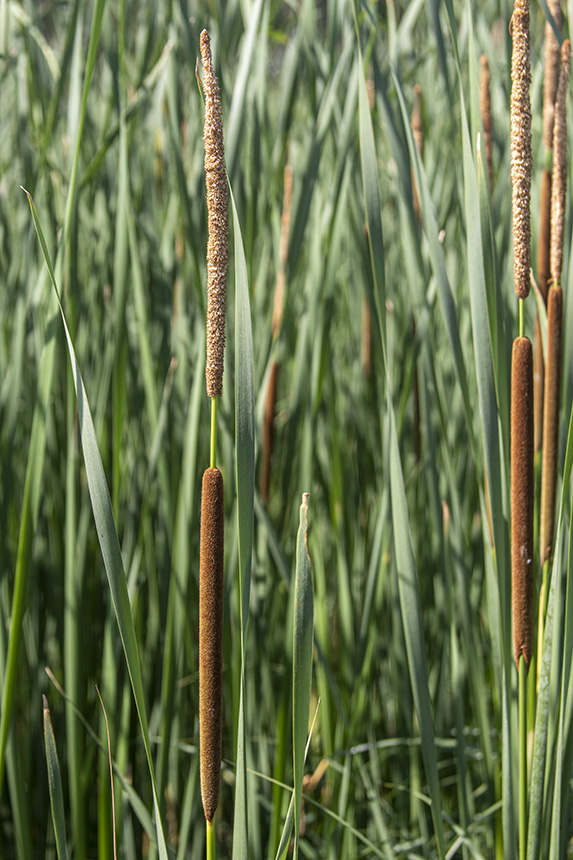
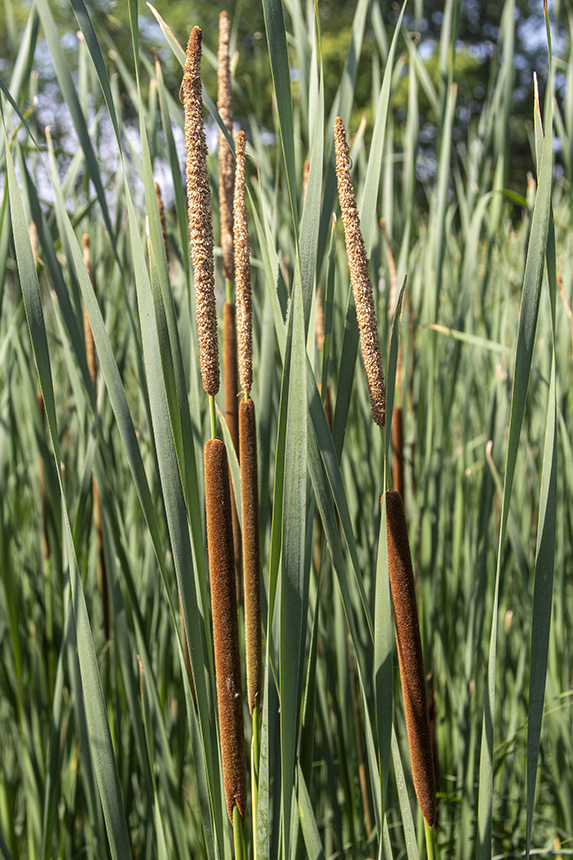
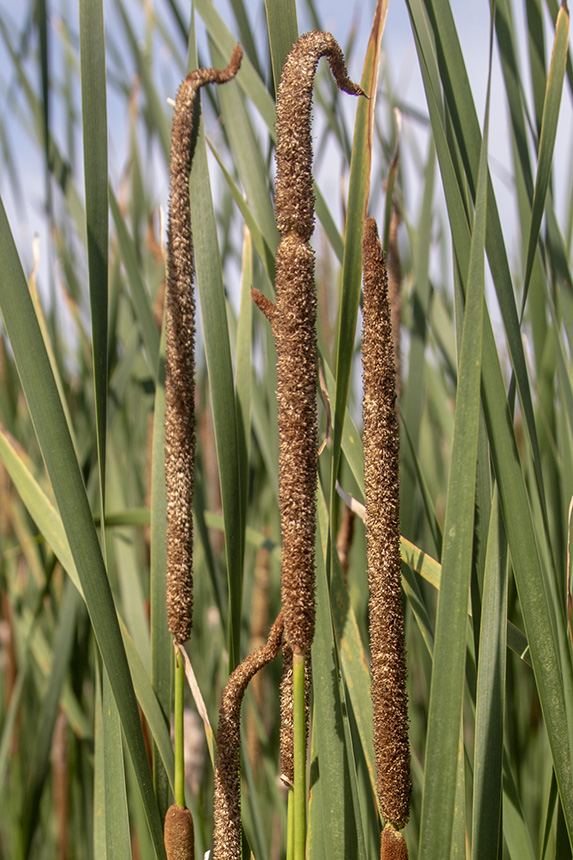
Narrow-leaved cattail is a 3″ to 9″ tall, erect, perennial forb that rises on a single stem or cluster of stems from a thick, mostly horizontal, unbranched rhizome. It grows in muddy soil, often with its roots underwater. The stems are erect, stiff, unbranched, light green, hairless, and round in cross section. They are 3 ⁄16″ to ½″ thick in the middle, 1 ⁄16″ to ⅛″ thick near the inflorescence. The leaves are mostly basal, alternate, green, and linear. They are slightly concave on the upper side, convex on the underside. They are ⅛″ to ½″ wide, usually rising well above the flowering spike. They sheath the stem at the base and taper to a sharp point at the tip. They have parallel veins but do not have a prominent midrib. When fresh they are not glaucous. The inflorescence is a dense spike of minute staminate (male) and pistillate (female) flowers at the end of the stem. The staminate-flowered portion of the spike is above and separated by a ½″ to 4¾″ long length of naked stem from the pistillate-flowered portion. When in flower it is ⅜″ thick and about as long as the pistillate portion. The male flowers are straw-colored to medium brown. The pistillate-flowered portion of the spike is 2⅜″ to 8″ long and 3 ⁄16″ to ¼″ thick when in flower. When in fruit it is brown and ½″ to ⅞″ thick. The female flowers are dark brown at first, drying medium brown. The fruit is a thin-walled achene with hairs attached. |
||
Height |
||
3′ to 9′ |
||
Flower Color |
||
Brown |
||
Similar Species |
||
Broad-leaved cattail (Typha latifolia) has broader, green to grayish-blue leaves that are up to 1″ wide, flat, and extend only slightly above the flowering spike. The staminate spike of the flowering stalk is contiguous with, not separated from, the pistillate spike. When in fruit, the pistillate spike is 1″ to 1¼″ thick. Hybrid cattail (Typha × glauca) occurs in places where both broad-leaved cattail and narrow-leaved cattail are present. It is a hybrid with characteristics that are intermediate between the two parent species. |
||
Habitat |
||
Moist to wet. Marshes, ditches. Full sun. |
||
Ecology |
||
Flowering |
||
June to July |
||
Pests and Diseases |
||
|
||
Use |
||
|
||
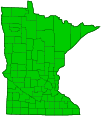
Distribution |
||||
|
Sources |
|||
| 3/4/2023 | ||||
Nativity |
||||
Native |
||||
Occurrence |
||||
Common |
||||
Taxonomy |
|||
| Kingdom | Plantae (Plants) | ||
| Subkingdom | Pteridobiotina | ||
| Phylum | Tracheophyta (Vascular Plants) | ||
| Class | Liliopsida (Monocots) | ||
Order |
Poales (grasses, sedges, cattails, and allies) | ||
Family |
Typhaceae (bulrushes, cattails, and allies) | ||
| Tribe | Typheae | ||
Genus |
Typha (cattails) | ||
Synonyms |
|||
Typha angustifolia var. calumetensis Typha angustifolia var. elongata |
|||
Common Names |
|||
bulrushes cat o’nine tails cattail Cossack asparagus lesser reed-mace nail-rod narrow-leaf cat-tail narrowleaf cattail narrow-leaved cattail reed mace rushes small reed-mace |
|||
Glossary
Achene
A dry, one-chambered, single-seeded seed capsule, formed from a single carpel, with the seed attached to the membranous outer layer (wall) only by the seed stalk; the wall, formed entirely from the wall of the superior ovary, does not split open at maturity, but relies on decay or predation to release the contents.
Glaucous
Pale green or bluish gray due to a whitish, powdery or waxy film, as on a plum or a grape.
Rhizome
A horizontal, usually underground stem. It serves as a reproductive structure, producing roots below and shoots above at the nodes.
Sheath
The lower part of the leaf that surrounds the stem
Visitor Photos |
|||||
Share your photo of this plant. |
|||||
| This button not working for you? Simply email us at info@MinnesotaSeasons.com. Attach one or more photos and, if you like, a caption. |
|||||
|
|||||
MinnesotaSeasons.com Photos |
|||||
Plant |
|||||
 |
 |
||||
Inflorescence |
|||||
 |
 |
||||
 |
 |
||||
Male Spike |
|||||
 |
|||||
Female Spike |
|||||
 |
|||||

Slideshows |
||

Visitor Videos |
|||
Share your video of this plant. |
|||
| This button not working for you? Simply email us at info@MinnesotaSeasons.com. Attach a video, a YouTube link, or a cloud storage link. |
|||
Other Videos |
|||
| Lesser Bulrush (Typha Angustifolia L.) - 2012-06-23 W3stlander |
|||
About
Published on Jun 25, 2012 Typha angustifolia L., ( also Lesser Bulrush or Narrowleaf Cattail or Lesser Reedmace), is a perennial herbaceous plant of genus Typha. --------------- |
|||
| Narrow Leaf Cattail in Minnesota Go Nutrient Negative! |
|||
About
Uploaded on Aug 1, 2011 Narrow Leaf Cattail in Minnesota requires a respond from the Minnesota DNR |
|||
| House Environment and Natural Resources Policy Committee 2/26/13 MNHouseInfo |
|||
About
Published on Feb 26, 2013 00:18 - Gavel. 00:40 - HF461 (Benson) Mechanical control of hybrid and narrow-leaved cattail rulemaking allowed without an aquatic plant management permit. 35:45 - HF657 (Hackbarth) Spearing restrictions removed from lakes. 1:03:25 - HF896 (Persell) Requiring the installation of electric fish barriers. Runs 1 hour, 49 minutes. |
|||
| Cattail and Bulrush part 2 jodajean1 |
|||
About
Published on Jun 28, 2012 A comparison between narrowleaf cattail and common cattail as well as a comparison between hardsterm bulrush and great bulrush. |
|||

|
Created: Last Updated: © MinnesotaSeasons.com. All rights reserved. |