



yellow sweet clover
(Melilotus officinalis)
Conservation • Weed • Wetland • Description • Habitat • Ecology • Use • Distribution • Taxonomy
|
|
||||||||||||||||||||||||||||||
Description |
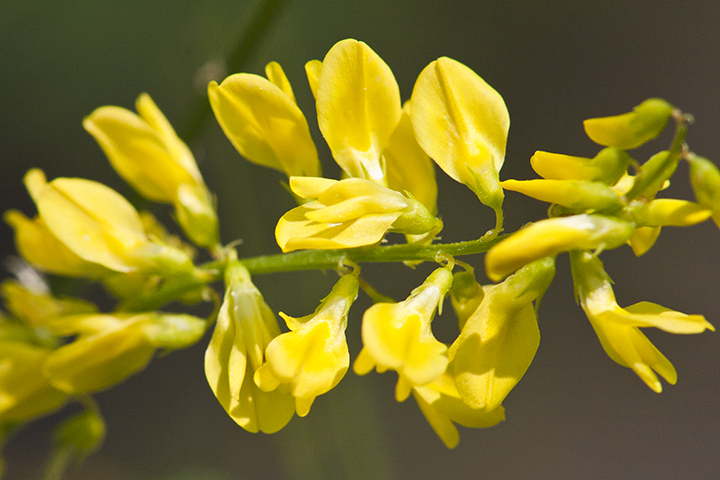
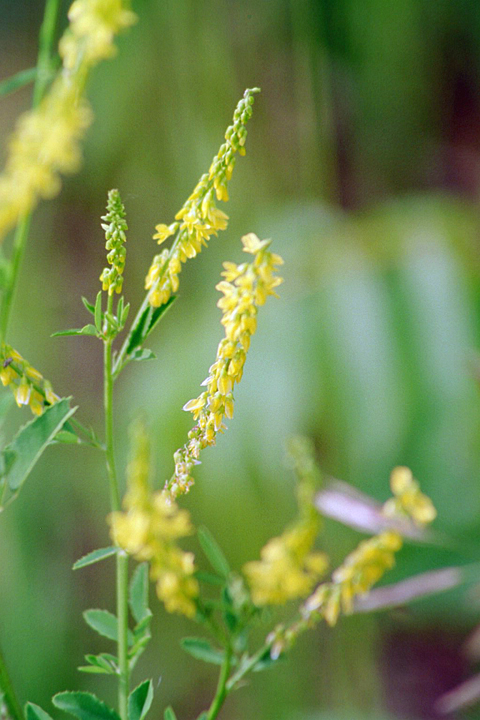
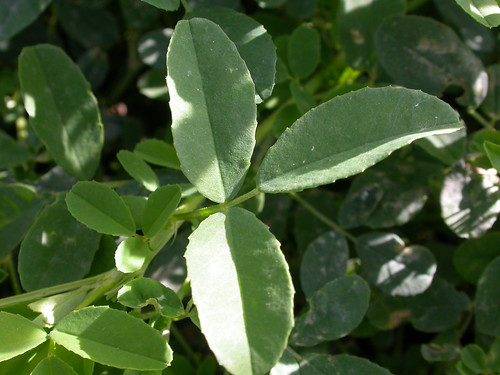
Yellow sweet clover is a 1′ to 6′ tall, erect, freely branching, biennial forb rising on many stems from a strong taproot. The stems are branching, light green, and hairless. The taller plants tend to be bushy, the shorter plants lanky. In the first year they are small and do not flower. In the second year they are taller, bushy, and produce many flower clusters. The compound leaves are alternate, hairless and divided into three leaflets.The leaflets are oblanceolate or obovate, ½″ to 1″ long and up to ¼″ wide. They are plain green, finely toothed along the middle and upper margins, the teeth pointed outward rather than forward. The middle leaflet is on a distinct stalk. The inflorescence is many tall, spike-like clusters of stalked flowers. The clusters are on elongated stems produced in the axils of the middle and upper leaves. The flowering stems are 2″ to 6″ long. Dozens of small flowers are crowded along the top two thirds of the stem. The flowers are ⅛″ to ⅓″ long and are attached to the stem with a minute stalk. They droop down but ascend at the tip. |
Height |
1′ to 6′ |
Flower Color |
Yellow |
Similar Species |
White sweet clover (Melilotus albus) has white flowers. It is usually a little taller than yellow sweet clover. The foliage is grayish-green, not plain green. It blooms 2 to 3 weeks later than yellow sweet clover. |
Habitat |
Dry. Open, upland areas, prairies, disturbed sites, roadsides. Full sun or partial shade, never full shade. |
Ecology |
Flowering |
Late May to September |
Pests and Diseases |
|
Use |
|
Distribution |
||
|
Sources |
|
| 9/3/2024 | ||
Nativity |
||
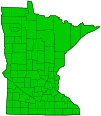
Native to Asia, Europe, and the Indian subcontinent. Introduced and naturalized in North America. |
||
Occurrence |
||
Common |
||
Taxonomy |
|
Kingdom |
|
Subkingdom |
Pteridobiotina |
Phylum |
Tracheophyta (Vascular Plants) |
Class |
|
Order |
Fabales (Legumes, Milkworts, and Allies) |
Family |
Fabaceae (Legumes) |
Subfamily |
Faboideae |
Tribe |
Trifolieae |
Genus |
Melilotus (melilots and sweetclovers) |
Some sources, including BONAP and USDA PLANTS, consider white sweet clover (Melilotus alba) and yellow sweet clover (Melilotus officinalis) the same species with differently colored flowers. It that is the case, then white sweet clover should be treated as Melilotus officinalis ssp. alba. BONAP lists Melilotus officinalis but not Melilotus alba. It does not list subspecies or varieties of any plants. USDA PLANTS curiously lists just sweetclover (Melilotus officinalis), with no subspecies, and with Melilotus alba as a synonym. Most sources treat white and yellow sweet clovers as separate species. |
|
Subordinate Taxa |
|
|
|
Synonyms |
|
Melilotus alba Melilotus armenus Melilotus arvensis Melilotus bungeanus Melilotus citrinus Melilotus diffusus Melilotus expansus Melilotus flavus Melilotus graveolens Melilotus officinalis f. suaveolens Melilotus rugosus Melilotus virescens Melilotus vulgaris Sertula arvensis Sertula bungeana Sertula major Sertula officinalis Sertula pallida Trifolium mauritianum Trifolium officinale Trifolium palustre Trifolium petitpierreanum Trigonella officinalis |
|
Common Names |
|
common melilot field melilot ribbed melilot yellow melilot yellow sweet clover yellow sweetclover |
|
Glossary
Compound leaf
A leaf that is divided into leaflets, each leaflet having the general appearance of a leaf, with all leaflets attached to a single leaf stem.
Oblanceolate
Reverse lanceolate; much longer than wide, thickest toward the tip, and gradually tapering toward the base.
Obovate
Reverse egg-shaped, with the attachment at the narrower end.
Visitor Photos |
||
Share your photo of this plant. |
||
This button not working for you? |
||
Alfredo Colon |
 |
MinnesotaSeasons.com Photos |
||
 |
 |
|
 |

Slideshows |
Melilotus officinalis |
|
About
Introduced taprooted biennial herb, stems often to 1 m tall or taller, leaflet margins serrate at least distally, flowers with yellow petals, pods inconspiuous, with 1 seed, common along roadsides, in fields, grasslands, and rangeland where overgrazed or intentionally seeded, does well where disturbance is regular, although seedlings, but not adults, are common in well managed sagebrush steppe. |
Visitor Videos |
||
Share your video of this plant. |
||
This button not working for you? |
||
|
Other Videos |
||
Yellow Sweet Clover (Melilotus Officinalis) - 2012-06-25 |
About
Published on Jun 27, 2012 De citroengele honingklaver (Melilotus officinalis), ook vaak Akkerhoningklaver genaamd, is een tweejarige- of meerjarige plant uit de vlinderbloemenfamilie (Leguminosae). |
Yellow Sweet Clover (Melilotus Officinalis) - 2012-06-11 |
About
Published on Jun 12, 2012 Melilotus officinalis, known as the yellow sweet clover, yellow melilot, ribbed melilot or common melilot is a species of legume. ---------- |
Environmental Laboratory - U.S. Army Corps of Engineers |
About
Published on Feb 15, 2013 Melilotus officinalis - Yellow Sweetclover |
Sweetclover 040412 |
About
Published on Apr 2, 2012 Agricultural Systems Management Degree in Yuma Presentation by: Tawnie Guerrero "Sweetclover" PLS 300 Weed Science Class |

Visitor Sightings |
||
Report a sighting of this plant. |
||
This button not working for you? |
||
| Alfredo Colon 7/7/2024 |
Location: Albany, NY |
 |
MinnesotaSeasons.com Sightings |
||

|
Created: 6/22/2006 Last Updated: © MinnesotaSeasons.com. All rights reserved. |